Engaging with Alan Duff

A Conversation with My Country by Alan Duff

(Random House, $38.95, 246pp)

New Zealand Books, Volume 29 | Number 3 | Issue 127 | Spring 2019

In 1990, a comet brightened the New Zealand literary scene and society with the publication of Alan Duff’s Once Were Warriors, for it involved both an extraordinary literary style and a powerful story.

It was welcomed in the very first edition of New Zealand Books by the late Bruce Stewart, a playwright, ex-prisoner and founder of the Tapu Te Ranga Marae, important to Wellington down and outs. He opened his review with

At last a Maori writer has managed to hang out all the dirty Maori washing with some kind of dignity and at the same time place the blame where it belongs. No other Maori writer has achieved this to the same degree – small loads of dirty washing yes, but not the front fence covered in rags and holey underwear. Most of the Maori writers have been careful not to hang it out in case the Pakehas would see it and use it against them. In the backyard – amongst themselves, it’s family and it’s okay.

This reader was struck by the novel’s vigorous and innovative writing but it also told a troubling story about New Zealand’s underclass and the horrific lives they can lead. I cannot recall that my focus was particularly on the Maori dimension of the narrative. Yes, that the characters were Maori was an integral part of the story. But I knew that while Maori were more likely to be members of the underclass, there were probably more Pakeha in total.

According to Duff in his A Conversation with My Country, a collection of essays around a common theme, many Maori, unlike Bruce Stewart, objected to the novel, because they thought it would be taken to reflect all Maori. The thought never occurred to me, because I already knew that there were more Maori who were not in the underclass.

One may be surprised at the reaction. The late Rosie Scott’s Glory Days, published two years earlier, is about the Pakeha underclass. One did not assume that it characterised all Pakeha; I even gave a copy to one of its (admittedly literate) members to help her understand her situation. Clearly the Maori middle class were much more sensitive.

Having been battered by his critics, Duff goes on to argue that Maori have done a lot better since the book’s publication, claiming that Maori are the ‘most well-adjusted, self-asserted indigenous race in human history.’ He says that he would not write Once Were Warriors again, because Maori culture has progressed far beyond Jake ‘The Muss’,

I would be more cautious. I plead no-contest to claims about being in the front of human history; they are difficult to define and defend, and usually extravagant. But the dysfunctional underclass is still with us although they are more involved with drugs than liquor  today. Moreover, to present Maori as if Jake was typical in 1990 ignores the majority at the time. Certainly most were at the lower end of the social scale but membership of the underclass was not predominant.

Duff is right that there is some movement up the scale over the years, but it is more incremental than he presents, partly by making the past worse than it was. As an example – there are many – Duff writes that All Black selection was once racist. But ‘in the last 30 years more enlightened attitudes have opened the door for more Maori’. In fact, the All Black team which finally beat the Springboks 63 years ago had five Maori, more than double their population weight. (Its captain, Bob Duff (no relation), was preceded by a Maori, Pat Vincent.) The protests which objected to excluding Maori from the tour to South Africa, beginning in 1949, reflected a recognition that Maori were being normally selected and should have gone.

The problem we all face understanding late twentieth-century Maori history is that the vast majority of Maori in the early twentieth century lived in rural localities. After the War they first trickled and then streamed into the cities. They were poorly prepared for the challenges of urban living. Some like Jake, sank, others flourished, most adapted. Duff is right that we should celebrate this adaptation and the success that has gone with it, but not uncritically, for the Jakes and Beths are still there.

The book discusses two ways of evolving the adaptation. Duff is proud of his books-in-homes program. Allow me a caution. His evidence for the program’s success is the number of distributed books, but there seems to be no systematic assessment of whether, or how much, they have changed lives. I have been in a middle-class Pakeha home with an entire wall of a filled bookcase, the occupier saying he had not read any of them. My mother, a high-school librarian, suggests a different solution. They named the school library after when she retired, not just for the way she had built up its resources but because she helped so many of the school’s students to get into the habit of reading. Duff tells a similar story of his father; it was not so much that his home had books but that he had a lifelong conversation with Gowan. The mentoring by parents, teachers, librarians, even neighbours is probably more important than the artefacts themselves (although, of course, they are needed).

I also caution about Duff’s second enthusiasm – education. Undoubtedly the discipline of schooling – attendance, classroom cooperation, literacy and numeracy and the like – is usually important for later success in life. But it could be argued that in a key respect the New Zealand education system is failing us. The poor quality of public discussion, and the uncritical popularity of some commentators, suggests that our students leave school unable to handle a complicated debate. Do they have any sense of the treachery of ‘truthiness’, that if something conforms to one’s views it must be true. We bemoan the phenomenon overseas, especially as it gives Donald Trump, and others, their popular base. The difference here is only one of degree.

To give a slightly complicated example which Duff addresses. He argues that blaming ‘colonisation’ and ‘racism’ for the problems of Maori is a major roadblock to further progress, Such political correctness prevents proper discussion; in order to move forward it is necessary to ditch  labels that make Maori victims and non-Maori oppressors.

I agree. Too often terms like ‘colonisation’ and ‘racism‘ – there are others – are a signal that the speaker has stopped thinking and does not understand the issues he or she is talking about. Labels become a block to progress not a pathway.

Duff has dislikes. We need to be more subtle than his views of gangs. Undoubtedly some, and some parts of others, are involved in crime and drugs and behaviour as heinous as Jake’s community. But are they all like that? Rather than starting off condemning them, we first need to know more. My hypothesis is that they are a social form arising from adapting to urbanisation, that we see only the prominent failures and not the quiet successes. We rely on truthiness.

Duff’s remarks on the welfare system are even more troubling. There are two broad views. Duff’s is that it encourages social delinquency and that the welfare recipients should get off their bums and look after themselves rather than relying on the state. The other is that a market economy inevitably fails to provide an adequate standard of living for all, especially for those doing valuable social activities outside the market, such as child-rearing, or those who lack the capabilities to earn adequate market incomes – the sick, invalids and the retired. The welfare system is a way of modifying market outcomes to address this failure.

Both accounts are, to some extent, correct, but applying the first diagnosis to those suffering the second condition is futile and corruptive (although it is terribly popular with the political right). What is needed is to address the second group, get that right and then address the residual; there are probably fewer bludgers than the right thinks.

While writing this review, but after the book went to press, the (latest) row in regard to Oranga Tamariki blew up. I know little about the facts of the originating case which involves a disputed uplifting of a newly born child from a Maori mother. There has been public outrage and some Maori are organising against the ministry, including objecting to its Maori name.

Recall its original English name was ‘Ministry for Vulnerable Children’, the adjective indicating that the agency was fundamentally dysfunctional in conception. The name was changed to ‘Ministry for Children’ although, as far as one can judge, nothing else has been done to address the underlying dysfunction. The ministry’s Maori name, ‘Oranga Tamariki’, was not changed, and has no overtone of vulnerability. It means ‘wellbeing of children’, an even better title than ‘Ministry of Children’,

It is true that the majority of children in state care are categorised as Maori – looks like the prison population, does it not? – but that was not true at the previous peak in 2008. What has happened belongs to another public discussion, which the Maori protest may be triggering.

My point is a simpler one. Once more we have given primacy to the Maori dimension of a phenomenon involving widespread failure and dysfunction. I would regret losing the name, ‘Oranga Tamariki’, for a functioning Ministry of Children although one appreciates the Maori frustration with the equating of this perfectly appropriate term with ‘vulnerability’.

I doubt that I would have written the last few paragraphs without the stimulation of Duff’s A Conversation with New Zealand. Many readers may dismiss the book because of its errors, its misunderstandings and its political conservatism – their truthiness against his. Instead they should take up his invitation to engage with a viewpoint which may have its limitations but is offering a conversation about one of the acutest issues facing Aotearoa/New Zealand.

Notes to Select Committee Considering the Zero Carbon Bill

Presentation on 26 August, 2019. The full submission is here.

Summary

1. Climate change and sea level rising is one of the greatest challenges the world faces.

2. New Zealand should play its part in the world’s effort to restrain greenhouse gas emissions.

3. I broadly endorse the intention of the Climate Change Response (Zero Carbon) Amendment Bill.

4. My recommendation is that all specific references to biogenic methane emissions should be removed and that methane should be treated on the same basis as all the other greenhouse gases.

Methane

5. Compared to carbon dioxide, methane is an especially burdensome greenhouse gas.

6. On the other hand, compared to most other greenhouse gases, it has a short half life – between 10 and 12 years. It is analytically important to distinguish between gross and net emissions in a way that is not as important for other  greenhouse gases. 

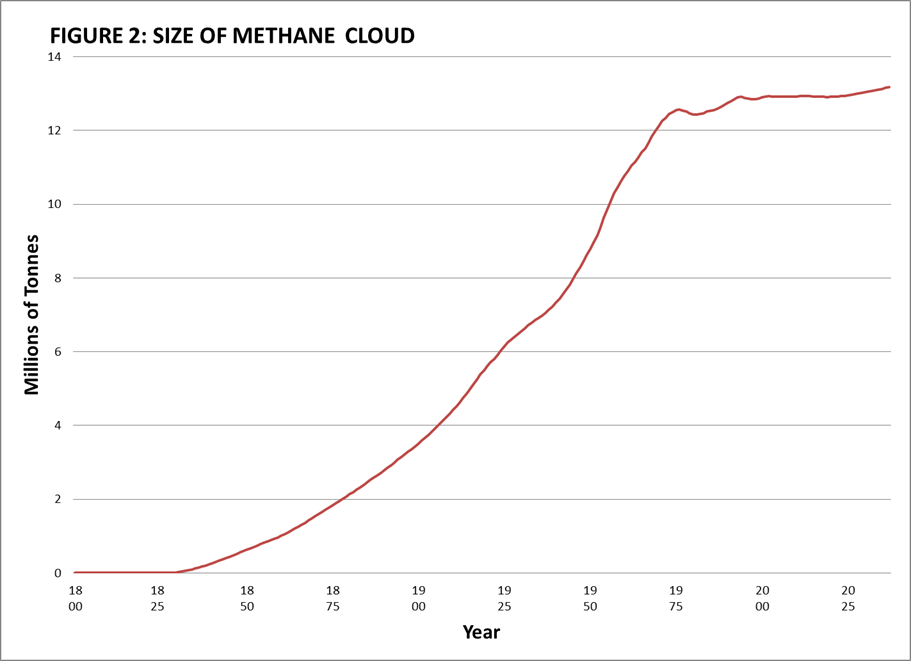
7. In the past New Zealand generated a substantial methane cloud, mainly from the past  expansion of its livestock industry.

8. However, the methane cloud is no longer increasing. That is because gross annual methane emissions have been (roughly) stagnant and are being offset by the breakdown of methane in the existing cloud. Thus while gross emissions are substantial, the net emissions are near enough to zero. 

9.Methane from the livestock industry is not adding to global warming as its current emissions are being offset by reductions in the effect from its past emissions.

The Proposed Legislation

10. The proposed legislation treats biogenic methane differently from other  greenhouse gases including thermogenic methane. It is not clear why it should be separated out.

11. In particular it is not obvious why biogenic methane, which is treated in gross terms, should be distinguished from thermogenic methane which is treated in net terms.

12. Nor is it obvious why emissions from fossil fuels may be netted off against carbon sinks (such as trees), while biogenic methane may not be netted off, especially against previous methane emissions.

14. Alternately it is not obvious why we should ignore the past emissions from fossil fuels which contribute to global warming but give the livestock industry no credit for the fact that its past contribution to global warming emissions is diminishing.

15. A further weakness of the bill is that it quantifies in statute precise targets for gross biogenic greenhouse emission based on experts’ best guesses about the technological possibilities of methane reduction thirty years on. That is bad law. (Also, what happens if they have underestimated the possible reductions? )

16. It is proposed that the new law treat biogenic methane the same as other greenhouse gases by removing all reference to it. Section 5O of the bill would now read

(1) The target for emissions reduction (the 2050 target) requires that-

(a) net emissions of greenhouse gases in a calendar year, are zero by the calendar year beginning on 1 January 2050 and for each subsequent calendar year;

The Effect of the Proposed Change

17 The proposed change would remove the anomalies and inconsistencies in the bill as it now stands.

18. It does not affect the intention of the bill, nor add to the challenges the proposed commission faces.

19. It does not reduce the urgency of the need to reduce gross biogenic methane  emissions nor of all greenhouse gas emissions.

In summary the references to methane in the bill are unnecessary, discriminatory, divisive and bad law.

NOTES ON SOCIAL COSTS STUDIES

This note is written in response to a request about the details of how to do a social cost study on alcohol (misuse). It is written by an economist who has long been involved in the area both theoretically and practically. [1]

The point of this note is that it is important to understand that there is a deep theory for social cost estimates as far as economists are concerned.  That creates a framework for the measurement of social costs. Economists doing a social cost should have recourse to the theory to apply the framework.

At the heart of the deep theory is the notion of that an economic cost is an ‘opportunity cost’ that is the cost of anything is the opportunity forgone. For an economist, then, one is always looking at an alternative,

In social cost estimation, the alternative is called the ‘counterfactual’ to be compared with the ‘actual’ situation. A social cost measurement exercise should always state what the counterfactual is. Without one the exercise is meaningless. There is rarely a unique or even obvious one.

For instance, it might be that the counterfactual is that there never has been any alcohol consumption, or it that all alcohol consumption ceases on a certain date or that on a certain date that alcohol consumption is reduced to the point where there was no misuse of alcohol although moderate consumption continued, or that there has never been any alcohol misuse. (The latter is the one I used.) Each counterfactual will lead to a different magnitude for the social cost.

(There is much puzzlement over the necessity of considering ‘avoidable costs’. They arise from a counterfactual scenario where, say, alcohol consumption had existed in the past but it stopped overnight. Costs arising from the past consumption will continue to occur after the cut off day (for instance there will be still be treatment costs and deaths from cirrhosis of the liver long after the cutoff date.) The costs are considered unavoidable and the counterfactual focuses on avoidable costs those that do not continue.)

The actual and counterfactual scenarios will have different outcomes. In principle a list is made of all the items in the two outcomes with particular attention to the differences between them. (For instance as alcohol consumption is reduced or eliminated, cirrhosis of the liver will decline.) The items are then valued according to the standards of economic ‘value theory’ thereby giv8ing two gross magnitudes, the differences of which is the social cost revealed by the counterfactual.

In practice every item is not identified – some remain the same, others are compared in aggregate. So the exercise is not as complicated as the previous paragraph might suggest. But that is the underlying notion and should be referred to when there is a doubt.

I do not propose here to discuss the valuation method that could end up a very long note.

However the implicit assumption is that all people’s consumption is valued the same, and that distributional issues are irrelevant. That is almost standard in economic analysis of alcohol consumption, except for some hand-waving. It is not my choice but I have found it difficult to offer an alternative paradigm. The best I can do is to split the aggregate into sectors – the recommended practice rarely followed in any detail. I add that this issue explains why transfers (such as taxes and benefits) are not included in social costs, although those not using the deep analysis sometimes get confused by how to treat transfers.

The simple summary is this. There is a well-developed tool in economics called cost benefit analysis (CBA), based on deep theory, with manuals that explain the framework and practice. It is used for many purposes, ranging from project evaluation to pharmaceutical evaluation. The economists’ approach to social costs of alcohol (and other drugs) is based upon CBA. Indeed done properly, were the need for a CBA arose, the calculations could use the cost-of-illness material. In effect the cost-of-illness exercise is a CBA with a particular counterfactual scenario. The rules and interpretations are the same.

One further issue needs to be mentioned. When CBA was first developed, it was applied to situations where the purpose was to change market output – GDP. However once it became used for analyses in the social sector, the issue of consequences in the nonmarket economy needed to be considered. For instance, two different methods of treating an illness may involve either the person being kept in a hospital or sent home. The first option impacts on GDP but the second has a similar impact on the care provided by the household which is not included in GDP. To ignore the household impact would be to bias treatments toward cost-shifting. Nowadays one would want to take the nonmarket sector into account in a CBA and therefore in a cost of illness study.

The issue deepens when one is concerned with wellbeing which is hardly measured in market GDP. For instance the effect of a pharmaceutical treatment may be to add to a person’s quality of life or to extend that life. The issue was not unappreciated in early CBAs. (One of my earliest introductions to CBA was how to deal with deaths in road accidents.) If this wellbeing is not taken into consideration treatments would be based in favour of one which resulted in shorter lives and greater discomfort for the patient because it was so much cheaper. The same analysis applies to social costs of drug measurement. In my experience the difference in quality of life/wellbeing aggregates far exceed to GDP ones.

[1]       e.g. International Guidelines for Estimating the Costs of Substance Abuse, 2ed (WHO 2003) (also Canadian Centre for Substance Abuse, 2002) with E. SINGLE, D. COLLINS, H. HARWOOD, P. KOPP, H. LAPSLEY & E. WILSON; and        The Social Costs of Tobacco Use and Alcohol Misuse (Department of Public Health, Wellington Medical School, Research Paper 2)

Climate Change Response (Zero Carbon) Amendment Bill

Submission to Select Committee reviewing the bill

<>


July 2019                                                                                                            

Fundamental Recommendation

That the 2050 target in the legislation be defined in terms of ‘net’ methane emissions rather than ‘gross’ methane emissions.

Proposed Amendment

That all references to biogenic methane emissions in Clause 5O be deleted.

In particular the current proposed clause 5O

5O Target for 2050

(1) The target for emissions reduction (the 2050 target) requires that—

(a) net emissions of greenhouse gases in a calendar year, other than biogenic methane, are zero by the calendar year beginning on 1 January 2050 and for each subsequent calendar year; and

(b) gross emissions of biogenic methane in a calendar year—

                               (i) are 10% less than 2017 emissions by the calendar year beginning on 1 January 2030; and

                               (ii) are at least 24% to 47% less than 2017 emissions by the calendar year beginning on 1 January 2050 and for each subsequent calendar year.

(2) In this section, 2017 emissions means the gross emissions of biogenic methane for the calendar year beginning on 1 January 2017.

Should be amended to

5O Target for 2050

(1) The target for emissions reduction (the 2050 target) requires that—

(a) net emissions of greenhouse gases in a calendar year, other than biogenic methane, are zero by the calendar year beginning on 1 January 2050 and for each subsequent calendar year; and

(b) gross emissions of biogenic methane in a calendar year—

                                (i) are 10% less than 2017 emissions by the calendar year beginning on 1 January 2030; and

                               (ii) are at least 24% to 47% less than 2017 emissions by the calendar year beginning on 1 January 2050 and for each subsequent calendar year.

(2) In this section, 2017 emissions means the gross emissions of biogenic methane for the calendar year beginning on 1 January 2017.

So that it reads:

5O Target for 2050

The target for emissions reduction (the 2050 target) requires that net emissions of greenhouse gases in a calendar year are zero by the calendar year beginning on 1 January 2050 and for each subsequent calendar year.

It will also be unnecessary to define ‘biogenic methane’ in Section 4(1).

Short Justification

There is no need to separate biogenic methane from other emissions (including non-biogenic (thermogenic) methane).

            It penalises farming unnecessarily;

            It involves arbitrary targets;

            It overachieves the stated aim of the proposed legislation, and

            It makes the legislation and its implementation overly complicated;

Background

Methane is a greenhouse gas which contributes to global warming. It is unusual in that its half-life is relatively short – 10 to 12 years – which means that (biogenic) methane being emitted in 2019 while the legislation is being passed will make virtually no contribution to global warming by the target date of the legislation (2050).

This is because of the nature of the methane cycle. The breakdown from livestock methane is, in effect, to nothing. Its carbon came from atmospheric carbon-dioxide converted into grass, eaten, ruminated, belched and as methane breaks down, eventually returned to atmospheric carbon-dioxide, completing the cycle.

This is already happening. Gross methane emissions from livestock have been stable for about four decades. As a consequence, for some time net livestock emissions – that is, current gross emissions offset by past emissions breaking down – have been near zero; sometimes slightly positive, sometimes slightly negative.

(The methane cloud generated from New Zealand livestock emissions is about 13MTs (million tonnes) of methane. In 2017, around 1.1MTs of it broke down into atmospheric carbon-dioxide. Meanwhile our livestock belched another 1.1MTs – almost exactly the same as the breakdown tonnage.)

Measuring, as the proposed legislation currently does, biogenic methane emissions in gross terms and ignoring the offsetting breakdown of past biogenic methane emissions does not make sense in terms of the purpose of the bill while also complicating its implementation.

Longer Justification: It Penalises Farming Unnecessarily

The farm sector may reasonably ask why other sectors are entitled to use offsets to their emissions while farmers are not. For instance, a motorist using petrol which emits carbon dioxide is permitted to use carbon sinks (such as trees) to offset her or his contribution to global warming.

Farming is also penalised compared to industry sources of non-biogenic (thermogenic) methane, which in the proposed legislation is treated in net terms. Why the legislation makes the distinction is unclear.

It is not at all evident – fair or wise – that the farm sector should be asked to bear a higher share of the burden of New Zealand’s campaign to eliminate net greenhouse gas emissions.

Longer Justification: It Involves Arbitrary Targets

.

Leaving aside whether it is a good principle to include specific quantitative targets in legislation (and the rather odd phrase ‘ at least 24% to 47%’, for the significance of last two words is unclear) the targets are, at best, guesstimates and contestable. They assume certain scientific advances which may, or may not, come to pass.

It would seem unwise – if not heroic – to project scientific achievements three decades out, let alone to also legislate any such projection.

Longer Justification: It Overachieves the Stated Aim of the Proposed Legislation

The purpose of the amendment is zero carbon emissions by 2050. The effect of the legislation, if successful, will result in negative net emissions for New Zealand by that date.

The reason is that emissions which are not biogenic methane will be in balance, but biogenic methane’s contribution will be negative, so that, overall, net emissions will be negative.

If the real purpose of the proposed amendment is that New Zealand should be a negative contributor by 2050, that purpose should be made clear, perhaps by replacing the ‘zero’ in the bill’s title by ‘negative’.

Longer Justification: It Makes the Legislation and Its Implementation Overly Complicated

The legislation is long and complicated which adds to the difficulty of implementation. The proposed amendment deletes ten unnecessary and complicating lines.

Moreover, by focusing on net emissions for all greenhouse gases rather than treating some GHGs differently from others, the proposed target is more understandable.

Conclusion

The recommended change makes the legislation more coherent and the implementation of the amendment’s intention simpler.

It does not exempt biogenic methane from the exercise. Insofar as livestock emissions can be reduced, they will make the overall target easier. But any reduction needs to be approached in the light of the application of scientific developments. They will, no doubt, be carefully monitored by proposed Climate Change Commission.

There is nothing in the submission which denies the urgency and importance of the world limiting climate change by reducing the warming effects from greenhouse gas emissions.

References

The underlying technical paper is

            New Zealand’s Methane Cloud

<><> <>NEW ZEALAND’S METHANE CLOUD<>

A non-technical account of the paper is

            Up in the Clouds

<><> https://pundit.co.nz/content/up-in-the-clouds