Barbarians At The Library Gates

The burning of books has a long history. That it no reason why we should add to it.

If you want to get Burning of the Books: A History of Knowledge Under Attack from the National Library you may have to hurry. It is in the overseas nonfiction section; many books of which are being thrown out. One hopes that at least some of the librarians intelligently read this book before they dispose of it. Written by Richard Ovenden, director of Oxford’s Bodleian Library, it tells of numerous disgraceful episodes in human history when libraries were wholly or partially destroyed.

Some instances involved accidents or collateral damage from war. Sometimes there were barbarians who did not know what they were doing. Sometimes the barbarians knowingly destroyed a library, In 1812 the British deliberately burned the US Library of Congress because they thought that would reduce the effectiveness of the American government. Sometimes the destruction was for ideological reasons as when the Nazis destroyed Jewish libraries or when Christians in Sarajevo purged Moslem texts.

The exact reason that our National Library is disposing of its overseas collection may be one of the above – like ideological reasons purifying New Zealand culture from overseas contamination or perhaps trying to limit the effectiveness of a thinking government. The NL spent $20,000 on a publicity campaign which, it says, did not get its message across. Sometimes the message is so unconvincing that dollars cant get rid of the smell.

Ovenden’s book may give one reasonable parallel. The Great Library of Alexandria declined gradually over the course of several centuries. Part of its collection had been accidentally burned by Julius Caesar in 48BCE, but it is unclear how much was actually destroyed. The Library survived for another three centuries. Its demise involved both the purging of intellectuals and underfunding. Sound familiar?

Many public agencies have suffered from underfunding, but the National Library’s (and Archives New Zealand’s) difficulties have been compounded by its odd place in the government system. It operates as a division of the Department of Internal Affairs, which is a collection of miscellaneous activities. The DIA seems to think that centres of knowledge are a bit like a registries for birth, deaths and marriages or the passport office.

(There is a claim that the National Library lacks storage space or that it is very expensive. That cannot be entirely true because parts of its building have been used by the DIA for other purposes. One was a passport office which many people thought was an insult to the integrity of the National Library and to knowledge.)

One hesitates to mention, because a mad generic manager is likely to seize on the idea, but suppose Te Papa, the national museum and art gallery, was under the DIA. Presumably the department would have insisted on purging all of Te Papa’s overseas-sourced artefacts and works – they are very costly to store, you know.

Instead, Te Papa is a separate crown entity under the Ministry of Culture and Heritage, which values books in a way that the DIA does not, as an integral part of knowledge, culture and heritage – as an integral part of a civilised society.

A curious feature of the story is that our librarians seem to have shown little resistance to the purges; the main resistance having come from the literate, appalled at the cavalier approach to the storage of knowledge. Ovenden gives no example of librarians ‘burning books’. When the Nazis were destroying the Jewish collections in Vilna (Latvia) they had to rely on Jewish librarians who did their best to subvert the exercise. Perhaps one day some of our librarians will tell similar stories.

The consequence of it all is that it sets an uncomfortable precedent. I am not suggesting that schools and public libraries will start burning books, but they may be tempted to disconnect their users from overseas publications and thinking. The National Library claims to want to promote literacy but it is not setting a good example. My Mum was a librarian – Hillmorton High School named its library after her – who took the view that it did not matter what her students read; the task was getting them reading and they will move on to more substantial works.

It is not an accident that the National Library started in the Department of Education as the Country Library Service in 1937. (It became the National Library Service in 1945.) Nor is it an accident that the last effective minister of libraries, Marian Hobbs, had previously been a headmistress. (She was very effectively supported by Helen Clark, who was Minister of Culture and Heritage, and Michael Cullen, Minister of Finance.) She strengthened the independence of the NL but the following National Government compromised that independence by putting it into the department of registries and miscellaneous affairs (not, you notice, the Ministry of Education or Minister of Culture and Heritage).

Since then, ministers have been cyphers following the DIA advice. The last, Tracey Martin, an NZF minister in the Ardern-Peters Government, more concerned to kowtow to the DIA than to lead it – a common feature of the rump of ministers – authorised the disposal of the overseas collection, despite infringing the spirit of the Hobbs National Library Act. (The new minister, Jan Tinetti, was also a headmistress.)

Still, there has been some progress. The disposed books are not going to be burned but pulped. Those concerned with climate change will be so pleased – except that books of interest to them are to be pulped too.
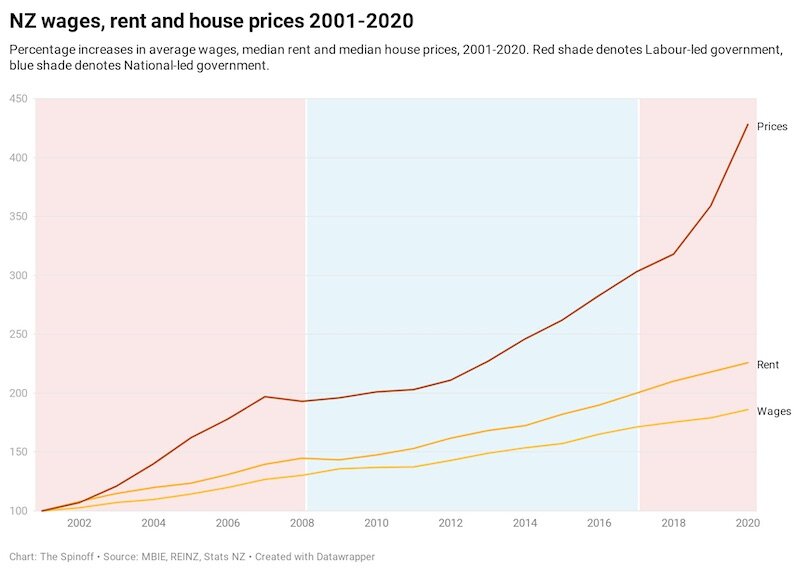
The Sources Of House Price Inflation.

Building more houses is not going to reduce house prices much (although it will help more people to be decently housed). The inflation driver is financial speculation based on leveraged borrowing. Until that is addressed, house prices will continue to boom.

<>housepricegraph.jpg

Policies based on theories which do not fit the facts are not going to work. Thus it is with most of the suggestions to control houses prices. The most salient fact about house price inflation is illustrated in the shown graph. (It comes from Duncan Grant published in Spinoff.) Since 2002, house prices have been rising substantially faster than rents and wages and consumer prices. There have been two bouts of very rapid house price inflation but there was stagnation from 2008 to 2012. (For a longer but not as up-to-date series.)

It is difficult to explain this graph by claiming we have not been building enough houses. We did not suddenly slow down house building in 2002, speed it up during the GFC and slow it down once the economy recovered from the global shock. (In fact construction fell after the GFC.) Certainly there is a housing shortage and we should be building more houses. But that will not have much effect on overall housing prices.

The faulty policy conclusion arises from a reliance on supply-side economics (which is part of the neoliberal framework). Of course one should pay attention to the supply-side of an economy (as we did in the previous paragraph) but we should not ignore the demand-side. Sometimes it dominates behaviour and has to be managed. Indeed, given that the disjunction between housing price trends and general price trends was evident by at least 2007 and attention solely to the supply-side has proved ineffective in repressing the prices for over a decade since, we might think to have learned.

Why have those prices been rising faster since 2002 compared to their past pattern? What changed then? There was an enormous injection of international liquidity following the Bush II tax cuts. That enabled New Zealanders to borrow more offshore, via their trading banks, greatly leveraging their housing equity. So the high house-price inflation is the result of a speculative spree financed by offshore borrowing. (It may not be coincidental that the housing price inflation seems to have accelerated following the Trump tax cuts.) Cheap interest rates have not helped.

When world liquidity closed down during the GFC, it became harder to borrow offshore, people became risk adverse and, not surprisingly, the speculative spree was retarded until the liquidity recovered in the mid-2010s.

Speculative booms are difficult to manage. They are not helped by tying one’s hands behind one’s back by ruling out a capital gains tax. That would both make the speculation less profitable and suck extra cash out of the speculative market, in effect reducing the amount of oil being poured on the flames.

Another approach is to reduce financial leveraging. That is what a loan-to-value ratio regime does. The difficulty is that borrowing is necessary for those purchasing a home for a first time. One way around this would be to have higher LVRs for such purchasing compared to the ratio for second home purchasers and those increasing their leveraging by upgrading their housing. While this might be difficult to administer nationally, the RBNZ is reintroducing a more tiered scheme and trading banks are tightening up their criteria for lending.

The neoliberal hands-off framework tends to argue that dealing with speculative booms is not a concern of a minimal government. While the social costs from speculating on a lottery, bitcom or a game may be negligible, once there is borrowing lenders will be exposed too. It is not so much the speculative boom that is the problem but the speculative bust which follows, especially the pressure from those collaterally hurt for taxpayer bailouts. Government stabilising the boom before the bust is prudential.

The neoliberal pays little attention to the distributional consequences of a speculative boom. Leveraged speculation is only possible for those who have some wealth (or can convince the financial markets they have it – Trump?). So during the boom there is an increase in wealth inequality. Practically that means that those low in financial wealth – as most of the young are – are excluded and cannot buy their own homes.

In the bust, the increased inequality may not simply reverse. Certainly some high flyers do badly but often it is those with a modicum of wealth who suffer, while those who were arranging the lending go scot-free.

For example, a lot of people invested their surplus savings in finance companies before the 2008 GFC and lost their shirts when it turned out that the companies were into high-risk investments. But most of those who managed the poor quality investment continue to wear collars and ties.

In summary, the government which ignores a speculative boom does so at cost to it, or perhaps its successors, and certainly to the economy as a whole.

I’ve not written a lot about the policies to quell the speculative boom; the above are chiefly to illustrate the underlying mechanisms. For all the public hysteria, the government may not have many policies available to it either.

If a speculative boom has been under way for almost two decades it is not going to be easily suppressed (except by a disruptive bust). Have you noticed that some of the loudest critics (including the National Opposition) did little when they were in office? (Which is not to ignore lamentable performances by some Labour Ministers of Housing; that excludes Megan Wood.) You only have to look at the way that the housing portfolios have been mucked around with – National split the supply and demand parts of the housing sectors – to see a shambles.

If this is a pessimistic prospect for housing – and, because of the sector’s size and importance, for the whole economy – at least this column has tried to provide an analysis consistent with the historical facts. However, policy proposals for this complex problem will be dominated by answers that are clear, simple, and wrong.

Is The King Above The Law?

While many readers will say ‘the king is certainly not above the law’, not everyone believes that, especially if they are in power.

The term ‘democracy’ is complicated and often used misleadingly. For instance, the ‘German Democratic Republic’ (a.k.a. East Germany), which was a part of the Soviet Empire, had one male in four reporting to the Stasi (secret police).

Allow me to cut through the complexities by suggesting that it is helpful to identify two sorts of democracies: ‘popular democracies’ stress the rule of the majority, while ‘liberal democracies’ give high priorities to human and civil rights – in effect, they stress the rights of minorities, including the individual. A generous interpretation of the GDR is that it was a popular democracy.

A government has to make coherent and consistent decisions. In effect, that requires a king – someone (or cabal) who is given enormous power. Liberal democracies restrain those powers by submitting the king to lawful constraints.

An example is in US constitution. By way of background, James Stuart (I or VI, depending on where you come from) argued for the divine right of kings, a political doctrine of monarchical absolutism, which asserted that kings derived their authority from God and could not therefore be held accountable for their actions by any earthly authority such as a parliament. They were above the law. In 1649 the English Parliament overruled the claim by executing his son, Charles I. (The English tradition of lawful dissent and rebellion goes back at least to the 1215 Magna Carta whose Article 61 provided for the barons to lawfully challenge the king.)

Such issues troubled the Founding Fathers of the American Constitution ratified 139 years later (so the regicide was closer to them than the signing of Te Tiriti o Waitangi is to us). In between there had been a long debate. Key was John Locke’s Two Treatises of Government, published in 1688/9, which argued that there was a ‘social contract’ between the populace and the person they designated as king. If the king did not act in their interests, Parliament had the right to replace him. (This was written at the time of the ‘Glorious’ Revolution, when Parliament dumped James II and called upon Mary and her husband William of Orange to govern them.)

Faced with providing for a powerful king (the President) and yet restraining his (or one day her) powers in the public interest, the US constitution contained a set of intricate checks and balances, including the impeachment process. Certainly the President was to be selected by a majority (as it happens, of a mix of voters and their states) but the minority interests had to be taken into account.

Not all monarchs/presidents accept this compromise. Instead they take it that they, like kings in fairy tales, had unlimited power barely constrained by law. Perhaps Donald Trump had but a superficial understanding of these issues, but Dick Cheney, vice-president to George Bush II, argued the case with coherence and vehemence.

It is instructive that when Al Gore lost to George Bush II and Hillary Clinton lost to Trump (both by smaller margins than the 2020 outcome) they did not throw Trumpian tantrums but accepted that is where due process had taken the outcome. Barack Obama must have had the gravest doubts about Trump – ultimately justified – but he smoothly handed over power to him. (Instructively, he made Airforce One available to the incoming president; Trump did not.)

In the long run, Trump’s reign may be remembered for the degree that the US constitution was robust enough to restrain a king who thought he was above the law. It did hold, but clumsily and sluggishly. The ultimate defence was that more people (and states) voted Trump out but what happened was a close enough to raise whether there needs to be some attention to the improving its robustness.

One step might be to get a wider understanding that a liberal democracy is not about rule by the majority. Rather the majority chooses the ruler who may reflect its values but is is constrained by liberal principles. That is why we do not just need functional literacy – the ability to read advertisements and orders – but an education which includes an understanding of civic rights and responsibilities.

It is not simply about being above the law of the land. Both Putin of Russia and Xi of China were elected for limited terms but changed their laws to eliminate that restraint. Recourse to using a majority in ‘parliament’ to change the law to increase the king’s power is a familiar ploy in popular democracies. As well as China and Russia, the list of popular democracies includes Brazil (Bolsonaro), Hungary (Orban), India (Modi) and Poland (Morawiecki). The signal is when the rights of minorities are compromised or dissent suppressed. Tot these examples up and there are an awful lot of people who live in democracies of the popular rather than liberal kind.

It is easy for those in New Zealand to hunker down in a liberal democracy, although the Trump episode reminds us we cannot isolate ourselves (as, indeed, does our economic dependence upon China).

However, we also need to be careful not to get trapped in a populist framework. It has become more prominent since the October election with a common theme among some commentariat: that since the government has a majority of seats in parliament it is not constrained and may do what it likes. The side-deals Labour did in the previous three years were not necessarily failures of the democratic process but integral to it. (I did not agree with many of the compromises but I am so often in a minority I have learned to live with them.)

It being this time of the year, it is worth pointing out the Article Three of Te Tiriti o Waitangi is a statement that New Zealand was to be a liberal democracy (albeit they had in mind a nineteenth century notion – we progress). Earlier drafts of the treaty actually had the provisions of Article Three in the prologue preceding Articles One and Two as in a social contract.

Because all this is so familiar we can forget the principles of liberal democracy, especially when we are (always temporarily) in the majority. Each of us is in a minority of one, protected by the principles of liberal democracy with the danger – as Trumpian America illustrated – of backsliding. I am grateful that one out of four friends does not have to report me to the Stasi.

How Is The Economy Doing?

The Treasury forecasts suggest the economy is doing better than expected after the Covid Shock.

John Kenneth Galbraith was wont to say that economic forecasting was designed to make astrology look good. Unfair, but it raises the question of the purpose of economic forecasts. Certainly the public may treat them as horoscopes which is usually the way they are reported. For a professional the forecasting exercise is an opportunity to think systematically about the state of the economy.

In normal times a forecasting exercise is a bit routine because nothing really important changes much, When I headed a forecasting unit, we added the challenge each time of tackling a new issue. However, the last year has hardly been routine and the challenges have been there without having to think up new ones.

I am going to review the year of Covid by tracing through the Treasury forecasts. Treasury has one of the larger forecasting teams and tends, in any case to be in the middle. Moreover they, and the RBNZ, need to get their forecasts as well as they can because they have operational consequences for fiscal and monetary policy. (Also Treasury forecasts are publicly available in some detail.)

Compare the forecasts in the budget forecasts known as BEFU20 – Budget Economic and Fiscal Update – made in April 2020,a month before the budget, and HYEFU20 – Half Year EFU – made in November 2020 and published in December. A more detailed – and much longer – report would show a steady evolution after the Covid Shock as new evidence came in (and would include the Pre-election EFUs).

The big surprise is that the EFUs show that the economy has done much better than expected.

Of course, the Covid Shock was a surprise and caused a scramble among forecasters. You can get a sense by comparing BEFU20 with HYEFU19 – done in November 2019 when there was nary a virus on the horizon. The Treasury was then forecasting a volume GDP growth in the year to June 2020 of 2.2 percent. In the middle of the April lockdown, Treasury lowered their forecast to a decline of (i.e. minus) 4.6 percent, so they were thinking the economy was taking a hit of 6.8 percent across the year, most of which would have been in the single quarter of the lockdown. (So they were thinking of a collapse of production of roughly 25 percent in the lockdown quarter.)

As the data has come in, performance proved better than expected and the economy contracted by only 2.1 percent in the 2019/20 year; still a big hit. Recall the headless chooks running around saying that the lockdown was too expensive so we should take the covid deaths and keep the economy open. Those who kept their heads are allowed to puzzle why we did better than expected.

My view is that we underestimated the resilience of the domestic economy. (No, not the success of the government policies – they were already factored into the Treasury forecast.) The sort of things I have in mind range from the lady whose rural restaurant lost custom so she designed mail-ordered fashion masks. Or the travel reporters, who having their tripping to Shangri-la, stopped found all sorts of interesting places in our backyard.

It is one of the benefits of the market liberalisation of the 1980s. I noticed it in the early ’90s when unemployment rose to postwar record highs yet those who became unemployed found jobs after looking for only a few months. (We are not nearly as good at showing the same flexibility when it comes to exporting.)

Post-covid unemployment is expected to track higher than if there had been no virus, rising from about 4-and-a-bit percent in the earlier scenario to 6-and-a-bit on current forecasts – say an extra 70,000 souls. We would expect a short-term bump in unemployment from the shock, but the Treasury seems to think it will be more persistent. During the April lockdown they assumed that the world economy would recover soon enough; today they expect it to grow more slowly and that affects the prospects for our exports which are a major driver of the economy.

Treasury is currently expecting the economy to do better than they did in April, with some expansion in the current year (to June 2021), despite the unexpected (partial) Auckland lockdown last August. The economy then grows reasonably well. (Even astrological forecasts get fuzzier as they look further forward.)

It is a big picture forecast being presented here. There is a lot more detail in the Treasury figures which keep the nerd-forecaster busy. Mention has to be made of the net Core Crown Debt. In the pre-covid forecast in the 2019 HYEFU the Treasury expected it to total $76b in June 2024. Following government’s massive fiscal injection to cushion the Covid Shock the 2020 BEFU thought the figure would be $201b in 2024. That has been pulled back to $194b in the 2020 HYEFU. So the fiscal package is slightly cheaper than was initially projected.

People go on about government debt as if is wicked. That, given low interest rates, the cost of the debt is near zero does not mean that is necessarily so. The real issue here is who is, or will be, holding the government debt as an asset in their balance sheet AND what they will do with it. It seems unreasonable to expect them (whoever they are) to hold the asset at a near-zero rate of return. They are likely to want to convert it to what seems to give higher rates of return – speculative housing, collectibles, shares and status goods, such as expensive cars (the standard use of overseas travel being largely ruled out for a while).

I am going to have to come back to this conundrum in later columns. It is an example of how short-term success can have long-term awkward consequences (one of the hardest lessons to get across to teenagers).

In the interim, we may take some relief that the economy has dealt with the Covid Shock better that was expected – even after allowing for a sensible government response – probably because we are a more resilient people than we normally assume of ourselves

Opening Pandora’s American Box

All nations have shadows; some acknowledge them. For others they shape their image in uncomfortable ways.

The staunch Labour supporter was in despair at what her Rogernomics Government was doing. But she finished ‘at least, we got rid of Muldoon’, a response which tells us that then, and today, one’s views of Robert Muldoon, prime minister 1975-1984, are shaped by one’s political position. Even so, his memory looms large in New Zealand politics.

Trump will leave a longer memory. (I am not equating Trump and Muldoon, and I insist that despite each nation’s shadows, most Americans I have met are, like most New Zealanders, decent ordinary people.)

One of the curiosities of Muldoon is the frequency he, or someone like him, appears in New Zealand literature. I once listed 15 novels and plays which might be said to contain Muldoon-like characters; he appears in poems as well.

Karl Stead tells a story which casts light on what was happening. His 1971 novel Smith’s Dream, a kind of political version of Man Alone, had prime minister Volkner portrayed as an ugly dictator. Stead probably had in mind Sid Holland, prime minister during the 1951 waterfront dispute, although there are hints of Hitler and Mussolini. When the novel was made into the 1977 film Sleeping Dogs, Ian Mune played Volkner as a thinly disguised Muldoon. This led to an exchange between Stead and Muldoon:

‘The only time I met Muldoon he told me he’d arranged for a private showing of the movie made from the novel … “because people were saying it was about me”. He was on an official visit to the university when he told me and, trying to be a good host, I said “You were only a cabinet minister, fairly junior, I think, when I was writing that book.” (One imagines that Muldoon grimaced. Stead goes on…) My wife said “Yes, you’ve just grown into the role.” Muldoon hoisted his cheek and laughed his ‘we are not very amused’ laugh.’

The role? There is a shadow in New Zealand’s history of the tyrannical dictator which Muldoon took over. In Jungian psychology, a shadow is that hidden, repressed, for the most part inferior and guilt-laden, personality whose ultimate ramifications reach back into the realm of our ancestors. Nations have them too.

Probably MMP has meant that the prime minister can no longer be a thug (hopefully, I will never regret writing that) but most New Zealanders have met male and female bosses who can easily be so characterised. Are they more common today, perhaps as result of the new managerialism, or just more evident?

This is not the only shadow which stalks our land; the treatment of Maori is another but it requires a separate column. Shadows stalk all nations. The events of last week confronted America with a deep one.

The American shadow is darker and goes back long before New Zealand’s first European settlers, even before the 1789 US Constitution. The founding fathers, who drafted it, were moved by inspirational sentiments such as the Declaration of Independence’s ‘We hold these truths to be self-evident, that all men are created equal, that they are endowed by their Creator with certain unalienable Rights, that among these are Life, Liberty and the pursuit of Happiness.’ The constitution itself begins ‘We the People’ affirming that the government of the United States exists to serve all of them.

Yet the founders had blind spots. It was just 100 years ago that American women were given the right to vote. The US has largely worked that one through politically, although there is still much gender inequality. One cannot say that they have worked though the 1865 amendment which abolished slavery – following a brutal civil war. Even today many Americans operate as if the Declaration of Independence does not apply to men and women of colour.

Whatever racism there may be in New Zealand, it is slight compared to that which exists in many (but not all) parts of the US. Over the last four years one has been continually confronted by the shadow, especially as the US President has done little to guide his supporters towards a more decent view of those who are not white. (Tut, tut, Brian. Euphemisms. Trump bloody well stoked the fires of racial resentment. Ed)

Recall that Trump’s predecessor, the admirable Barack Obama, was half black and treated with contempt by a large section of America. Faced with a terrorist attack on a black church, Obama went to the pastor’s funeral and sang ‘Amazing Grace’. Yes, they are right. He is very different from Trump.

Sure, Trump lost the election, but 70 million Americans voted for him. Some would have voted agains the Democrat ticket because the new vice-president Kamala Harris is a woman who is half Indian and half Afro-Jamaican. (On that measure they would not have voted for any of the five main New Zealand parties.)

But it is not only many Americans who are racist. So are many of their institutions. Compare the riot on 6 January 2021 with the huge Black Lives Matter protest in Washington on 1 June 2020. The authorities were then prepared, with a force made up of Washington police, US Park police, more than 5,000 national guard troops (many in full body armour) and federal agencies like the Bureau of Prisons plus an army helicopter. It is not sufficient to observe that in both instances the response was under the command of the, oh so culpable, Trump. Those directly in charge in January were not properly prepared either, treating black demonstrations differently from white ones.

The American shadow is so dark and deep that it will not be easily lightened or lifted. Even if Trump’s political life ends, the shadow will still be there to be taken over by others. They are likely to be smarter and more sophisticated than Trump, although they may lack the charisma which attracts Trump’s most devoted supporters.

Whatever happens, Trump is likely to symbolise that shadow for a long time – a Muldoon writ much larger; evil to some, hero to others. A political ‘crucifixion’ will only make the hero a martyr. Those who think he is a rogue must await the judgment of the courts or the financial markets, not a partisan political deliberation (no matter how attractive its contribution to splitting the Republicans may be).

Pandora’s box has been opened. The demons are out; they cannot be pushed back in. They must be faced; that will take a long and painful time and much effort.

A New World Order?

Does the US need to strike a grand bargain with like-minded countries to pool their efforts? What does this tell us about today’s global politics?

Perhaps the most remarkable editorial of last year was the cover leader of the London Economist on 19 November 2020. Shortly after Joe Biden was elected president, that stalwart of sensible liberal business wrote that in order to deal with China’s increasing influence ‘America needs to strike a grand bargain with like-minded countries to pool their efforts.’

It was an open admission that the US was no longer powerful enough to take on any other country by itself. The Economist was not arguing that the US was no longer the most powerful country in the world, Rather, that the gap between it and the others was shrinking.

Of course the hegemon always wears the crown uneasily, and there has been a constant flow of claims that the US dominance was economically or militarily challenged by another – the EU, Japan, Russia, as well as China. But in the past the solution was that the US should sort out the threat by itself. The Economist has concluded that it may be no longer powerful enough to do that.

For while the US has been the frontier economy leading the world, it is increasingly easy for other economies to catch up. There is an economic theory, for which I see both merit and evidence, that eventually the world will return to the situation before 1750 when economic power was distributed in proportion to the population of each country. That day, when per capita incomes are approximately equal across all countries, is a long way off, but you already can see the movement towards it. The EU and Japan have already caught up.

China is still a long way behind the richest countries in per capita terms but it is now, on some measures, the largest economy in the world as a consequence of its huge population. That gives it enough economic surplus to exercise an awful lot of muscle – arguably too its centralised government makes it easier for it to use its power.

But even if the US has a huge economy, it is finding its reach limited. It is still the biggest military power in the world but its generals warn they are not able to fight major conflicts on two fronts. (Who else might even try?)

The diminished power of the US is acknowledged by even Donald Trump and his followers. His slogan ‘MAGA’ – Make America Great Again – implies that America is no longer great. The diagnosis, though, is hopelessly wrong. America’s diminishing authority is not because its leadership lacks the will and that a strong leader would restore US leadership (shades of Nietzsche), nor that the ‘deep state’ in Washington has been betraying the country (shades of McCarthyism).

So the relative power of the US is diminishing. Serious American thinkers acknowledge this but perhaps are not as willing to say too publically, given that the MAGA crowd are likely to accuse them of treachery. Barack Obama and his advisers were well aware of this situation and were trying to maximise their leadership leverage. However, many members of Congress – even senators – were (and are) more MAGA inclined.

Trump had the US running the fight single-handed. Old allies – ‘weaklings’ – were henchmen, not partners. The outcome of Trump’s policies was to leave a huge space in the international political order for China to fill.

Instead, the Economist is arguing that the strategy should be closer co-operation with like-minded countries. Its cover image has Australia, Britain, Canada, the EU, Japan, South Korea and the US holding hands in a linked circle.

New Zealand is too small to feature in such grand strategies. In any case we have problems which highlight its difficulties. It is certainly true that we are more comfortable with the seven in terms of their (mostly) liberal democratic institutions and practices, while our strongest military and intelligence relationships are, broadly, with them. But China is our largest trading partner (although we export more to the seven collectively); it is also the largest trading partner of Australia, Japan and South Korea, three of the Economist’s seven.

How to tread the path between the two sides? The uneasy example is China’s recent treatment of Australia which has been bully rampant, signalling a threat to the US. That is the danger of being a small ally of a large power: the other side may pick on you to make an example.

MAGA America appears to have given little support to Australia in its conflict with China. I imagine that Biden’s America will offer more. But MAGA reminds us that the US may not always be reliable. Trump’s legacy has been to weaken America’s ability to provide leadership, because no one can trust it in the long run.

Biden’s more sophisticated understanding of the international order can only provide some remediation, especially as Congress is unreliable. Recall that Obama’s new engagement with the Pacific included joining the TPP. Neither Trump not Hillary Clinton was committed to the deal. Whatever their personal views, they knew they could not have got it through a Congress where MAGA had sufficient support to block it. The MAGA crew are still there.

Uncomfortably then, the rest of the world are in the hands of a couple of big bullies. China’s direction may be clear but we are very uncomfortable with it, especially the internal repression which is especially acute in Hong Kong, Xinjiang and Tibet while there is increasing repression of freedom of expression throughout China.

We ought to be more comfortable with the US, but it is a far greater paradox – recall Churchill’s description of Russia as a ‘riddle wrapped in a mystery inside an enigma’. (He said that the key was national interest.) Much the same applies to the US.

How can a country with the finest cadre of scientists in the world be so scientifically illiterate – only a third of Americans believe in evolution? Its medical fraternity is equally world class so how has the US been able to make such an enormous cock-up over its response to a pandemic? I admire so much the American thinking on liberty, yet I look at their treatment of blacks. The country which dominates the world is populated by those who have little knowledge of global geography. It has been a leader in promoting the rule of law but finds its parliament building invaded by a mob supporting a president whose understanding of the law is, at best, tenuous.

Hopefully we will experience a saner US than we have seen over the last four years but that will not resolve the challenges the world faces.

After Brexit?

The deed is done, the doers undone

Had I been a Brit, I would have voted ‘Remain’ rather than Brexit (or ‘Leave’). Instead, I have been bemused by the comic theatre of British politics, fascinated by what the Brits actual think and professionally interested by the revelations of the complexity of the interactions between Britain and the (rest of the) European Union.

The complexity is summarised in the 2000-plus page agreement (and many loose ends which, when settled by negotiation, will add even more pages). It comes to three times the length of my Not in Narrow Seas and that is covering only 650m years of New Zealand’s history.

I never imagined how complicated was the totality of UK/EU relations. I began wondering what would have to be negotiated supposing there was a standoff between us and the Australians – something I hope never happens. It would not just be repealing the CER agreement but would involve a wide variety of other dimensions, which are beyond my competence to list, together with numerous informal arrangements – for instance, our attorney-general attends meetings of the Australian state attorney-generals.

I doubt the majority British voters in 2016 expected a 2000 page agreement signed at the last minute. They had been told that the deal was easy. What do they think now? Actually, it is not clear what the majority ever thought. The 2016 referendum gave 52 percent for Brexit but there was so much disinformation that it was unclear what was happening. More voted in the 2019 British election for parties which supported Remain than for those parties which supported Leave (say 55% to 45%). However the eccentricities of the British Front Runner electoral system gave the pro-Leave Conservatives a comfortable majority in parliament.

At the heart of the Brexit rhetoric was the demand that Britain exercise its sovereignty and ‘take back control’. ‘Sovereignty’ is a complicated term. On many matters – sometimes described as ‘cultural’ – Britain already had it. A country can decide on such matters as the choices at the end of life or how to regulate cannabis. That is true for member states in the EU which has a governing principle of ‘subsidiarity’ – that decisions should be made at the lowest level possible.

However subsidiarity does not work once exchange between economies is involved, as is well illustrated by the 2000 pages. Suppose one country has some regulatory standards. It will be reluctant to allow imports from another country which does not have these standards. It would be a fat lot of good, for instance, taking domestic measures to restrain carbon emissions and then consuming imports from a country that did not care. Similarly, as a general rule, one country will not allow another to subsidise exports to it if it compromises its local industries.

As a consequence, the EU requires Britain to maintain similar standards for its exports if they are to be tariff-free. So rather than take back control, the British freedom to regulate on such standards is limited. Norway and Switzerland, countries outside the EU but with earlier trade deals with it, complain they are bound by EU regulations despite having no say in their formulation. Britain might have a fraction more wiggle room, but it has hardly taken back control.

One stream in the Leave thinking was neoliberals who objected to the EU standards and thought that if Britain was in control it could set lower levels of consumer, environmental and worker protection in a no-deal option in which trade would be simply regulated by WTO rules.

It is unlikely that the vast numbers of those who voted Leave would favour the elimination of these standards – they were not neoliberals. Their concerns were about sovereignty in a wider, almost cultural, sense. One irritation was from the free flow of people between EU countries. Brexit restricts EU citizens’ right to live in the UK but the offset is that Brits lose rights of free movement throughout the EU.

In my judgement, the case for unlimited people mobility across borders is not as clear-cut as some economists argue. (I am less laissez faire in this regard than was the Key-English Government.) I can see that unlimited mobility is necessary in continental Europe with its permeable borders. Once the principle was there it was harder to justify restricting flows across The Channel/La Manche. There may be some gains here for some Brits if there be losses for others. The measures will impact unevenly. Now those on short-term holidays on the continent will have the ignominy of having to queue with us at points of entry.

Behind this is a British view that their country is more important than it is. Almost all countries claim to punch above their weight – we do too but we are still flyweight. Perhaps because of its imperial history British claims are excessive. The promise to out-negotiate the EU was absurd. Some 45 percent of British exports went to the EU but only 15 percent of the EU’s went to Britain (the latter proportion excludes member states’ exports to one another). This is not surprising given that the EU after Brexit produces more than five times as much as Britain. On the other hand, the EU’s structure of a confederation means it is not as politically cohesive as Britain, although sometimes that can be an advantage.

In contrast to its ambitions, Britain may find itself quite lonely in the world. Even New Zealand with its sentimental ties to Britain will prioritise the EU. Can Britain gather the equivalent of the 27 votes in the UN and the economic power that the EU has? It will be prone to be bullied by even a Biden-led US. That the EU rolled Britain makes it very vulnerable to the next bully who comes along to negotiate an FTA. We are offering one, of course, but this flyweight will insist on concessions for agricultural access.

Nor is there much expectation that the British economy will boom, although PM Johnson has claimed that. (That he has claimed to have done the EU deal better than promised does not give one confidence for this claim either.) The key factors may be the structural change which will become necessary and the rise in transaction costs across borders. Brexit has not simply been a neoliberal ambition, but I am reminded of the claims of the Rogernomes who confidently promised huge economic gains while knocking off 15 percent from our GDP.

Behind the comedy of British politics and the tragedy of the outcome, we can treat Brexit as an experiment – the first trade pact to reduce the flow of trade. Outsiders watch it to learn but, sadly, if one is fond of the best of Britain.

Reviews of Not in Narrow Seas

Michael Reddell. ‘Not in Narrow Seas’, Croaking Cassandra, May 30, 2020.

Brian Fallow: ‘Progress of NZ Economy Has Been a Rocky RoadHerald, 20 June 2020.

Joan Druett: ‘Not in Narrow Seas’, World of the Written Word. 21 June 2020.

Shamubeel Eaqub: ‘Brian Easton Will Now Harrumph’, Newsroom, July 2, 2020

Max Harris: ‘Book Review – Not in Narrow Seas’, Kathryn Ryan’s ‘Nine to Noon’, Radio New Zealand, 28 August 2020.

          May I correct an error? The review said that the 700 years of Maori is covered in only three chapters. In fact there are eight: 2, 3, 4, 5, 13, 30, 36, 57 while others have a significant Maori element including 8, 10, and 11.  Maori items in the  index take up almost two columns. Not in Narrow Seas is the most substantial analysis on the Maori economy since Raymond Firth’s Economics of the New Zealand Maori which is only about the pre-market economy. (My Heke Tangata covers only the postwar era.) For a Maori account of Maori history see Ranginui Walker’s Ka Whawhai Tonu Matou / Struggle Without End (1990) Second Edition (2004).

Gerald McGhie: ‘Review of ‘Not in Narrow Seas’, New Zealand Journal of International Affairs, November/December, Vol 46, No 6, p.28.

Giovanni Tiso: ‘Filling the Hollow Society’, Landfall 240 Summer 2020.

            Steve Braunias at Newsroom wrote that the best review of the years was ““Filling the hollow society” by Giovanni Tiso in Landfall. As you would expect, there were numerous really good reviews at New Zealand’s best books section; I think the best at ‘ReadingRoom’ this year were by Jesse Mulligan on the new Chelsea Winter cookbook, and Jenny Nicholls on Paul Spoonley’s demographic study The New New Zealand. Elsewhere, Nicholas Reid, writing for the Academy of New Zealand Literature, patiently and rigorously took apart Tom Scott’s biography of Charles Upham, and the always insightful Philip Matthews provided a masterclass of fiction reviewing with his review of Tally Stick by Carl Nixon, also at the Academy site. But the very best review of 2020 was by Giovanni Tiso in Landfall 240 of Brian Easton’s economic history Not In Narrow Seas. Tiso references WB Sutch, Bruce Jesson and Ranginui Walker as he places Easton’s great work in the tradition of important histories of how New Zealand was shaped. He talks about the book reaching “an undeniable crescendo”; the review operates that way, too, as both Easton and Tiso size up the trauma – and abject failure – of Rogernomics. This is first-class thinking and a joy to read.”

Jeremy Agar: ‘Not In Narrow Seas The Economic History Of Aotearoa’, Watchdog 155 December 2020, p.80-85.

Tom Brooking, Jim McAloon and Melanie Nolan gave excellent critiques at the November 2021 New Zealand History Association Conference. They are password protected.

Review By Jeremy Agar

Watchdog 155 December 2020, p.80-85.

Brian Easton has been researching the New Zealand economy for about 60 years. He writes that the pre-sent analysis is offered as a summary of his life’s work. By focussing on the economy, Easton wants to emphasise that it is how people earn a living that shapes social relations. As a text to explain who New Zealanders are and why, readers will find the book invaluable.

The title is derived from the poet Allen Curnow, whose often quoted thoughts about NZ were of “two islands not in narrow seas/Like a child’s kite anchored in the indifferent blue’. British migrants had ventured to a “A land of settlers/With never a soul at home”. Echoing Curnow, who wrote in the 1940s, the leading literary journal called itself Landfall. In 1933 Gordon Coates, the last Reform Party Prime Minister, remarked that before refrigeration, that is up to the 1870s, we were an isolated island.

Bruce Jesson- observed this cringe, which he saw as the immaturity of a “hollow society”. Unlike, say, America, which had evolved its way of life for generations before its successful war of independence, the migrants were starting from scratch. In these musings, Maori are absent, the general attitude being that they could mostly be ignored.

When Curnow wrote I was a small boy, but shortly after he was fretting about his narrow seas, I had my first political thought. My grandmother, born in Waimate, had referred to the UK as “Home”. I told her off. Despite that, I recall not being sure what country I was in. We kept hearing about England, the producer of books, singers, games, famous people, and there were waves of Brit immigrants in the immediate postwar years. Discussing this with a contemporary in my university years, my friend said she remembered the same confusion.

Perhaps this was a Christchurch thing? But Easton might say that it was in fact a countrywide thing. He points out that most of the early migrants were either from small farms in southern England or from Presbyterian Scotland. As a result, the crude Church of England versus (Ireland and) Catholic hostilities were not imported to any great extent (but note the final paragraph below). Many wanted nothing more than to own enough land to be able to farm and to be left alone. The culture was marked by pragmatism and moderation. Migrants wanted to escape the rigid class divisions and urban slums of the old world.

So, real life meant that the Wakefield plan to transplant British habits of class and ethnicity failed. He had wanted to set a “sufficient” price for land so that workers could not buy-in. He had envisaged an economy based on crops, but pastoralism dominated. In any case there was very little money around. Maori had some as they sold food to the settlers but most Pakeha struggled.

The widespread lack of capital meant the early farms often failed. Imported animal pests depressed productivity. Rabbits took over parts of Otago, forcing farms to be abandoned (astonishingly, only in the last few years has the importance of biodiversity and conservation values begun to attract serious attention. Seven generations after the rabbits first plagued and the gorse first spread, there are still political leaders who think looking after the environment would detract from economic performance).

Myths

Easton talks a lot about myths, pointing out that the frequent use of “myth to denote a false story is not its main meaning here. Easton’s myths are stories that might or might not be true. Often, they describe something that was real but has become less so. Myths are what we like to see, whether true or not. A unifying theme is that the popular political myths from history are almost always distortions, the Left being not as radical as its champions deem to be the case, and the Right being not as reactionary as it is often said to be.

This applies to the first Liberal and Labour governments, not really all that radical, and to Reform and National governments, not really all that awful. Circumstances create policies, and not vice versa, Easton insists, and NZ governments have (almost) always reacted to them as circumstances seemed to suggest, without preconceived notions.

The defining circumstance of post-European settlement has been town versus country. In this context the Liberals, personified by Richard (King Dick) Seddon, and Labour, by Michael Joseph Savage, are the townie tradition, and Julius Vogel was the chief architect of Reform and National. Perhaps so, as his ambitious public borrowing could be seen as foreshad

owing Piggy Muldoon’s “Think Big” schemes, but a social democratic history of investing in public infrastructure is also Vogelian.

The Quarry Economy

Both traditions were reacting to circumstance. Theory and grand ideals have seldom been in play. Another central theme in the book is what Easton calls the “quarry”, the extractive enterprises which the Governments of the UK and NZ saw as the purpose of New Zealand. Before organised migration to the main towns began in 1840, the islands that Abel Tasman had named were of interest only to restless men who hunted seals and whales.

The first Europeans were adventurers who saw the new colony as a resource for immediate exploitation. Untroubled by the thought of a permanent or regulated future, they hunted seals and whales to near extinction. Then, following organised migration, came the flax economy. Gold rushes saw Dunedin becoming the main city, whereas, after the kauri gum market declined, so did early Auckland, which was evolving past being just a quarry, but with links to Sydney, it became a focus for manufacturing and finance, and after Waikato’s swamps were drained, dairy boomed.Coal was first mined as early as 1849, and is still being dug up, but with at least some environmental awareness these days, it is going the way of the pre-Adamite seals and whales (in some parts of the country “Pre-Adamites” refers to the Europeans who pre-dated Government sponsored migration). The quarry economy attached itself to the town and country division. Coalmining, for instance, was at the core of support for Seddon, who represented Westland. Sheep farmers and suppliers tended to the Vogel strain; shearers and freezing workers, quarriers, to the Seddon strain.

One Big Sheep Farm

The product which most shaped the country was wool, which helps explain the historical dominance of conservative interests. The east side of both islands from Hawkes Bay to Otago was virtually a sheep farm. In 1882 the first refrigerated ship set off for the UK with frozen lamb and mutton. Butter also became a viable export, so the relative dominance of wool was eased as the economy became a bit more rounded.

The myth has it that a radical Scot in the Seddon government was so enraged by the feudalistic land-owners in the old country that he led the charge to break up the huge sheep farms. Easton does not even mention the brave warrior (John McKenzie), preferring a more mundane explanation. He discusses Ready Money Robinson, who farmed 90,000 acres around Cheviot in North Canterbury. He says the estate was broken up because of a family dispute, in the context of the emerging meat export market rendering the vast wool farms no longer viable.

According to Wikipedia, the farm, heavily in debt, was subdivided after Robinson’s death. His will had left the matter to his four daughters. They could sell if all agreed, as they did. Is Easton too eager in his myth busting? It wasn’t about just one family. In all, across the country 1,000,000 acres were subdivided, creating 7,000 smaller farms. That changed the country. Another historian has written that the difference in wealth between the Ready Money class and the poorest was more extreme than what had existed in France before their revolution.

Whatever. It was during King Dick Seddon’s day that the ethic that Jack was as good as his master began to dominate social discourse. Smaller farms meant more jobs and services in the provinces. The role of women became more appreciated, Seddon saying that they were a civilising influence. Easton’s essential point is upheld. It was changes in the economy and technology that led to Liberal dominance, not Liberal dominance that led to this enhanced democracy.

Yet it remained the case that only two animals, sheep and cows, and only one market, Britain, accounted for pretty much all NZ’s place in the global economy until the UK joined the European Economic Community in 1973. Or so goes another myth, but Easton argues that diversification of both products and markets was already under way. Otherwise, NZ would not have adapted to the new order as successfully as it did.

While the influence of the Liberal Party lifted living standards generally, for Maori, not living in sheep country, it was less so. The first land sales were limited to Governments, but this lapsed as private sales to settler farmers came to be allowed. Easton suggests that a reason for this was that the UK government never wanted to spend more than it needed to for basic law and order in its quarry, so cash-deprived NZ governments were relaxed about allowing private sales. They would have wanted to speed up settlement.

Maori land, communally owned and thereby less able to adapt readily to change, was less likely to prosper. Much of it was in the central North Island, remote from markets and rail links. So, Maori poverty persisted. Some lived frugally by choice, preferring traditional subsistence farming, as did quite a few Europeans. An impatient State, with a “use it or lose it” ethic, was unimpressed.

Easton provides statistics from 1900, by when early trends had settled in. Life expectancy for non-Maori New Zealanders, at an average of 58, was considerably longer than what the average Briton, American or Australian could expect, but for Maori it was considerably less than all four others, reaching the 1900 non-Maori level only by the 1960s.

Similarly, non-Maori New Zealanders were more literate than Britons, and taller, but Maori were often more literate than both, because Protestant missionaries wanted them to read the Bible. Life was tough for most. In 1900 11 of every 12 non-Maori babies survived, but less than half of English babies, and only a third of Maori babies, survived. In England more babies survived in the country than in (industrially polluted) towns. NZ now sees five in 1,000 non-Maori and seven in 1,000 Maori die in infancy.

In all these health and welfare measures, Maori have been closing the gap with other New Zealanders in every decade since the settlers arrived, but as we know only too well, the gap persists. Of course, the statistics are relative. NZ might have been more progressive and more egalitarian than the UK and the US, but, by present standards, for the majority life was a struggle through the first 100 years.

Consensus About Social Security

The tradition of moderation and compromise that held – until the 1980s’ Lange government’s assault on living standards – is exemplified by the consensus about the benefits of social security. Here again, Easton is keen to take us down the middle of the road. While Liberal and Labour governments were typically the original sponsors of welfare measures, Reform and National tended to accept the changes once they were in place.

But not always. Harry Atkinson, who put out early feelers for a Welfare State in the 1870s, was accusedof being “subversive of the social order”. In 1882 George Grey (sounding very much like Donald Trump) held that any attempts to better the lot of the working class would be “anti-family, anti-Christian, extreme communism”. Savage, the first Labour PM, saw them as “applied Christianity”. Sid Holland, the first National PM, saw them as “applied lunacy”.

Wanting a minimalist State, Governor Hobson in 1840 and his immediate successors – effectively the first Governments – had not taxed income and they did not invest in education and health, which is part of the reason that the 1918 flu pandemic claimed 8,550 lives. Following the conventional wisdom, Easton suggests that the start of modern policy came in two stages, the first from the Liberals at the turn of the 20th Century. They introduced pensions, female suffrage, industrial arbitration and other measures which, together, saw off the minimalist State.

The second stage could be dated to the first (1935-1949) Labour government. They built State houses and raised working class living standards. In 1938 the Savage government passed a Social Security Act, enabling the tradition of social democratic policy that still informs (if hesitantly) Labour today. By 1944 health, previously surviving on crumbs, was allotted 2% of GDP. It is now 7%. Significantly, in this time of Covid and recession, it should be borne in mind that, because of the Savage/Walter Nash investment in public welfare, NZ recovered from the Depression earlier than did the austerity regimes in the old world.

That progressive and humanist impulses have always co-existed with the minimalists is indicated by the 1852 thoughts of James Fitzgerald, Superintendent of Canterbury: “There is something awful to my mind in the prospect of a great mass of the community increasing in wealth and power without the moral refinement which fits them to enjoy the one or that intellectual cultivation which enables them to use the other”.

Or, take the recommendation of Bill Sutch, one of the country’s great civil servants, who argued in 1962 that “the greatest need was for the development not of ‘land’ nor of ‘capital’ but of the third, the ‘human’ factor in production”. The next year Sutch wanted to persuade Wellington that in “the mature economy… (an emphasis on) education, the arts, industrial design, housing and town planning and infrastructure’ is needed to guide policy. Without that focus NZ would remain dependent as a “neo-colony”. He was not just talking about the economy. To achieve real independence, NZ needed a social and cultural transformation. In Easton’s terms, Sutch was talking about how NZ might become more than a quarry.

What a pity it is that, 170 years after Fitzgerald and 60 years after Sutch, the minimalists still among us reject a humanist culture and think the only purpose of public education is to turn out products for the labour market. And what a pity that their quarry mentality holds that productivity is enhanced mainly by lowering wages, extending working hours, and exporting raw materials (in Canada, once another quarry, historians refer to how the country’s early migrants were seen to be “hewers of wood and drawers of water”).

After the early benefits of trading with unprepared colonists, Maori were mostly either on the land or in the quarry. Apirana Ngata, the much-celebrated champion of Maoridom, thought that most were “satisfied to live on minimal reserves, with seasonal excursions into the labour field”. He advocated “modernisation”, the need to move to towns and cities. In 1901 the Maori population was 45,000. In 1951 it was 135,000. At that stage, when economic growth in the country at large was surging, most Maori were still farming. Others were typically working in freezing works or construction.

More recently, the increased importance of urban jobs encouraged a significant Maori uprooting from the country to the cities and the ethnic wealth gap began to close. “A Maori born in 1974 had about as much training as a non-Maori born 30 years earlier”.38% of Maori worked as managers, professionals, technicians or trade workers as compared to 53% of non-Maori jobholders.

As the national economy grew, so too did an increased Pasifika immigration, but Rogernomics was soon to betray both demographics by closing down many of the very enterprises which had encouraged them to move in the first place. This was the root cause for much of the urban unrest and dislocation that worries us now.

Reluctance To Acknowledge Class

Easton, though, warns against the present obsession with associating brown people with child poverty, crime and unemployment, even if well-meaning liberals hope thereby to champion their cause. He points out a simple fact that the national conversation seldom acknowledges: the majority of poor households are non-Maori. “Part of this confusion arises because of the reluctance of New Zealanders to contemplate the existence of socioeconomic class. The consequence of the neglect is that the existence of a Maori meta-class – despite its considerable social graduations – is often used as a proxy for class analysis”.

A result of this bias is that “policies which target only Maori fail to address most of the poor”. This is why “middle class good intentions sometimes result in working class racism”. There is good reason to assume that, were NZ to have shared the severely racist past of, most obviously, the US, and were it to have encouraged a present tense Trumpist politics, we would have been suffering a comparable Deplorable breakdown into tribal division and hate.

Individual prejudices might exist, whether based on ethnicity or religion, but how much do we need to prioritise race relations? Easton suggests that as “most Maori have some education, have jobs, live peaceful and enjoyable jobs in societies, the current emphasis on culture and language has created a stereotype of Maori as failures”.

Referring to 2013, Easton looks at the comfortable class who were enjoying an income of at least $100,000 a year. It included 5.9% of non-Maori, but also 2.6% of Maori. The poorest, defined as those existing on less than $15,000 a year, comprised 29% of non-Maori and 36% of Maori. These numbers are close. What is not close is the difference between 100,000 and counting and 15,000 and not counting. The one big underlying fault line is not ethnicity but inequality, which hampers everyone. Here again the popular mythology is inaccurate. “Gross income inequality is slightly less for Maori” than for the country as a whole.

A reader of the main parties’ platitudes who did not have experience of living in NZ might be surprised that the 2017 election saw 29 Maori MPs in Parliament (a number essentially unchanged after the 2020 election). They included Winston Peters, Simon Bridges, David Seymour and Jami Lee Ross, but not Paul Goldsmith. As a quartet they do not strike one as being notably put upon, nor as champions of an equality of life chances. What all four happen to have in common is a distaste for placing ethnicity at the core of what public policy should consider. They are not alone. Easton reports that one in six New Zealanders report Maori ancestors (how many of us know all about our ethnic antecedents?).

To see how we all got to where we are now, we could go back 75 years to the third period of policy development, when the present Labour/National dominance emerged. For the first two decades after World War 2 pastoral exports were humming along so well that there was no pressure for governments to adapt policy to suit a world that was changing. Easton thinks that is part of the reason NZ policy makers succumbed to the Rogernomic attack so readily. They had not been thinking about the need for fresh approaches.

Nation Yet To Recover From Neo-Liberalism

Easton counts five long stagnations in NZ’s post-colonial history, all but one of which were brought about by external factors that little NZ was powerless to resist. The exception is the Lange/Douglas recession. That wound was self-inflicted. For ten years from 1985 the dogma of neo-liberalism went unchallenged and unabated, resulting in an economic contraction so severe that it was not until 1995 that the economy returned to the level from which it had started. In the meantime, deep austerity and National’s subsequent Ruthanasian slashing of welfare investment and benefit payments created generations of deprivation that disproportionally affected the poor. The nation is yet to recover.

Easton shows that at the core of neo-liberalism was a wish to transfer wealth to the already wealthy through tax cuts. A severe increase in inequality was the intended and necessary result. Giving the one per centers more did nothing to help the country at large, there being none of that mythical trickling down that resulted. Public resources were reduced by the same amount as private riches were increased. End of story.

Earlier complacency was one thing, but another reason for the lack of progressive response to the Rogernomes was that the Kirk/Rowling Labour government (1972-1975), admirable in other ways, had done nothing to anticipate life after the collapse of wool prices from the mid-60s, Kirk having little interest in economics. The pastoral economy had peaked in 1966 when wool provided 91% of exports. It now reaches 3%. Then followed nine years of Muldoon’s very traditional ministrations. So, almost everyone outside the Beehive when Labour’s coup against its supporters was launched was unready.

We’re given an insight from as far back as 1904, when Andre Siegfried remarked that a New Zealand propensity to be “scornful of scientific thought makes them incapable of self-distrust. Like almost all men of action they have a contempt for theories; yet they are often captured by the first theory that turns up. They propose simple solutions to the most complex problems with astonishing audacity”.

He could have been talking about 1985, when the State was in thrall to a handful of young economists just back from picking up the fad of economic libertarianism, largely from American academies. We’ve critiqued them all in these pages ever since, and nothing we have said needs to be amended now. When Lianne Dalziel, Christchurch’s Mayor, sought financial advice – should the city sell its assets? – she went to Rob Cameron. Cameron is known for a long history of pushing for all and any public assets to be privatised. That is what his company is there for.

Dalziel knew what the answer would be. Even after 35 years of neo-liberal failure, some (at least) Labour politicians have not changed their spots. In the name of growth, growth and more growth Cameron and his mates contrived to shrink the economy, which through the Rogernomic years grew at 15% less than it had previously. The experiment was “an abject fail ure”. Siegfried would not have been surprised that the ideologues despised empirical research so they did not know that in the Savage/Peter Fraser era the economy had grown faster than even their own imagined rate would have achieved.

In contrast, during the manic years between 1988 and 1993 unemployment averaged 8.7%. Just as you can simultaneously develop human social potential and financial wellbeing (Savage) so can you simultaneously deprive human potential and shrink gross domestic product numbers (Roger Douglas).Helen Clark used to point out that if you are in a hole you should stop digging, but this was not advice that the Rogernomes, with their cult-like faith in untested theories, would have appreciated. They preferred the “ludicrous argument” that the failures were the result of the Lange, Palmer, Moore and Bolger governments not having dug themselves even deeper into debt and inequality.

Easton quotes Geoffrey Palmer’s 2014 opinion that the civil service then would have been unable to carry out 1985 reforms, so massive had been the assaults on administrative capacity and institutional memory. Implicit in the narrative is that the first two years of the Kirk government were pivotal. Big Norm, enormously popular, has assumed an iconic (mythical?) status in Labour circles. He left school at 12. He built his own house. Only the third Kiwi-born prime minister, he was also its first genuine working class leader, being neither a former union official nor a full time party official. And he will certainly be the last such leader.

It was the Kirk team that introduced the country to the idea that NZ could challenge the foreign policy assumptions of the UK and the US, and it was the first to take internationalist perspectives such as expressing support for the UN. Kirk spoke up against South African apartheid, and the 1975 Treaty of Waitangi Act introduced the country to all the related policies and processes that have followed.

In some ways Kirk was a child of his time. He seemed unaware that women were burning their bras and looking up at glass ceilings, and he did nothing to reform and democratise economic policy. Looking back, it might seem surprising that it was not until 1977 that the National Anthem asked God to defend NZ rather than asking Her to save our gracious Queen. Kirk had gone by then but he had prepared the ground for this simple flowering of independence and maturity.

Labour’s Focus On Identity, Not Economics

The subsequent Labour focus on identity, diversity and culture, as opposed to economics, can be dated from this time, as can the trend for the Party’s politicians and supporters to emerge from the professional classes rather than the working classes (is this another reason for Norm’s big reputation? Did Labour feel it had to reward the retiring era with a gold watch?).

Curiously for such a moderate and unemotional observer, Easton flips in the occasional unsupported generalisation. He talks of NZ’s “extraordinarily effective system of governance”, and even of an economic “miracle”. He’s probably referring to the bureaucracy, which gets more credit, even if it is often implicit, than the politicians do. Some civil servants are expressly praised. Clarence Beeby, in education, is singled out, which is fair enough, but why not Sutch?

As part of Easton’s myth busting, none of the PMs who are habitually exalted are much so here, but a couple who are usually ignored are picked out for praise. NZ’s first settlers might have thought they were in narrow seas but, following Kirk, the Ardern government has the potential to look up from the provincial quarry and see across the oceans.

When Jacinda was reminding Judith that Collins is living in the past, she was saying that the time when the needs of the quarry economy dictated policy about everything else has been and gone. In common with successful societies around the globe, a mature post-colonial NZ is moving beyond crude extraction.

Time For Quarry Economics To Be Scrapped

As Thomas Piketty insists jobs based on sheer physical labour are inevitably becoming fewer and remuneration for toiling at them will continue to lag. Technology and services will continue to dominate. Education is going to become increasingly necessary. This much should be obvious.

Easton does not try to forecast where to from here, but we can give it a shot. The 2020 election could be seen in Eastonian terms as being at least, in part, an expression that the country is ready to move beyond the quarry economy and the quarry culture, the incoming Government not having to endure the carping of New Zealand First, the one Party that has been all quarry.

There’s a myth that Easton treats only lightly, the one that has it that only the National Party can understand economics. This is myth in the sense of being untrue, and there has never been a rational reason to believe it. And now, at last, the 2020 election has purged the fake news. Neo-liberalism has long been discredited. Could quarry economics join it in the scrap heap?

As a hint as to what changes in attitude and policy might suggest themselves, consider the lot of the Irish. Up until about World War 2, male Irish New Zealanders tended to be hampered by an imported discrimination which induced them to be stuck in the various quarries or else, as in America, in limiting alternative ambitions to being a cop or a priest. Yet, as the economy broadened in the era of post-war growth, this long anachronistic hangover of imperialism vanished. After just a few years any lingering class or ethnic or religious biases based on British history were unimaginable.

ECONOMISTS AT WAR: How a Handful of Economists Helped Win and Lose the World Wars: Alan Bollard

New Zealand International Review, January/February 2021 Vol 46, No 1: p.28-29

(Oxford University Press, Oxford, 2020, 321pp, £20)

The outcome of a long war is usually determined by the economic strength of the combatants. But how to present this in a lively and interesting way — battles are so much more engaging?

Alan Bollard successfully solves the challenge by describing the involvement of seven economists in the Second World War. Bollard is, of course, well-known as a former secretary of the Treasury and governor of the Reserve Bank. But he has also published a couple of novels, a biography of economist Bill Phillips, a record of his time at the Reserve Bank and some more technical economics books. In addition to considerable literary competence, his geographic background is also wide. His doctorate was a study of the Cook Islands and after his local top-level stints he went on to five years as executive director of the Asia Pacific Economic Cooperation (APEC) Secretariat. So, while he is well-versed in Western economics, his war focus is not only on the Western Front.

Thus, his account of the Second World War begins with the Japanese invasion of Manchuria in 1931. Enter his first economist, Takahashi Korekiyo, who was the head of the Bank of Japan and Ministry of Finance. (Earlier he had been a prime minister.) At the time, Japanese politics was dominated by its military; their demands for financing their ventures were insatiable. (Bollard reports that in 1944 Japanese military spending was 76 per cent of GNP; New Zealand’s was about 51 per cent, similar to the proportion of its allies.)

The military demands required a monetary expansion of a magnitude which would appal any governor of the New Zealand’s Reserve Bank. Takahashi resisted. (Earlier he had, according to Ben Bernanke, ‘brilliantly rescued Japan from the Great Depression’.) The military overruled him in the only way they knew; he was assassinated in his bed in 1936.

Takahashi was well aware of Japan’s economic problem of requiring raw materials but he saw the solution via trade rather than conquest — rightly presaging the success of the post-war Japanese economy. (There is a parallel for Germany.)

The book shifts to Kung Hsiang-hsi, a Chinese minister of finance with many other roles. He was brother-in-law to President Sun Yat-sen and President Chiang Kai-shek (see Jung Chang’s Big Sister, Little Sister, Red Sister). In the 1930s and 1940s there was a three-way war between the imperialist Japanese, the ideological Communists and the corrupt Nationalists. Kung presided over the latter’s financing, while taking his margin, which made him, it was said, the world’s richest man.

Thence to Germany’s Hjalmar Schacht, who served in Adolf Hitler’s government as president of the National Bank and became minister of economics, although he had lost power by 1939. The challenge for him was similar to that of Takahashi and Kung: funding a fiscally undisciplined government bent on warfare. (Short answer: credit creation followed by inflation and shortages.)

Schacht nicely illustrates that the book has the wrong preposition in its title (an admiring review is allowed the odd grumble). In fact, it was ‘Economists in the War’, not ‘at war’. Schacht’s proposals for post-war international momentary reform were built on by Maynard Keynes, despite being on the opposite side of the conflict.

Inevitably, Keynes is the central figure of the seven. Yet he is also transitional, as the book shifts from economists centred on fiscal and monetary management to fund warfare to three who used mathematical economics to enhance the war effort. (Keynes was an able mathematician among his other glittering talents, which included being a stylish writer.)

The three were Leonid Kantorovich of the Soviet Union, Wassily Leontief, a Russian refugee in the United States, and John von Neumann, a Hungarian refugee also in the United States. (The first two were Nobel laureates, the third and Keynes would have been had they lived long enough.) Their contribution was to improve the efficiency of resource usages.

Among Kantorovich’s contributions was designing the route across the ice of Lake Lagoda which muted the siege of Leningrad (now St Petersburg). He is best known for his inventing linear programming, which was (twice) independently invented in the West. The book nicely captures some of the exciting intellectual developments in economics at the time. (I had not realised the importance of the development of computers to the profession.)

Leontief worked on targeting bombing more effectively using the input-output analysis he developed and von Neumann (who is said to have been a model for Dr Strangelove) on the even bigger bombs — at Hiroshima and Nagasaki — where Bollard ends the Second World War (the official Japanese surrender was a week later). This is all written with a droll humour, reporting that in 1939 von Neumann wrote a ‘paper on ‘Estimating Probable Error from Successive Differences’, or, in lay terms, ‘where to aim bombs if you have already missed the target several times’. (Bollard reports that post-mortems suggest the bombing was not as important as was thought at the time.)

The book ends with two chapters on the aftermath of the war and the beginnings of the Cold War which enable Bollard to wrap up the lives of the six economists who survived (although in Keynes’s case by only eight months). There is also a useful appendix which summarises the war time economic policy approaches; military schools may well pore over it.

So we have a rattling good narrative offering a different approach to the Second World War. Other readers may just enjoy following the lives of the seven economists. Like the profession they were politically diverse — a loyal nationalist, a self-aggrandiser, a capitalist Weimar social democrat, a classic British liberal, a Russian apolitical, a centre-leftist and a hard rightist — although a phrase never really captures political views. Bollard also gives their family backgrounds, using them to link the men. Keynes, for instance, had a devoted marriage with a Russian ballerina, Lydia Lopokova, but even he could not extract her family from Leningrad; Kantorovich’s ice bridge did more for them. None of them were particularly likeable except, perhaps, Takahashi, although they could be charming; this proposition does not generalise.

With luck, underpinned by an open world economy, we shall not have another long war to test again the notion of the importance of economic strength in warfare. Shorter conflicts will depend on the sort of efficiency considerations to which economics and allied professions contribute.

But there is a kind of world war at the moment, involving an invasion of ‘Martians’ disguised as coronaviruses. As countries open the spending taps to fight it, economists and others would do well to review the fiscal and monetary experiences of Japan, China, Germany and Britain fighting the last one.

Filling the Hollow Society by Giovanni Tiso

Review of Not in Narrow Seas: The economic history of Aotearoa New Zealand by Brian Easton

Landfall 240 Summer 2020

Some years ago, a friend on a brief visit from the UK asked me to suggest a few introductory books on the history and politics of New Zealand. I gave him three from my own library: W.B. Sutch’s Quest for Security, Ranginui Walker’s Ka Whawhai Tonu Matou; Struggle Without End and one of Jane Kelsey’s books on the neoliberal reforms. The first two had been important texts in my own education as an immigrant in the late 1990s, while the third grappled with events that changed the New Zealand known by my partner, who finished university and left for her OE just as the first Bolger government came to power in 1990.

Making sense of the country in those years wasn’t easy: it felt like the scene of a recent explosion, its collective trauma still largely unprocessed. In my search for clues I came across outgoing Prime Minister David Lange’s valedictory speech, in which he took time to ‘thank those people whose lives were wrecked by us, because we did do that’—an extraordinary admission for a politician to make, even while maintaining that his government’s actions were ultimately justified and necessary. Yet the public debate on this and other matters seemed practically non-existent: either I didn’t know how to navigate the public sphere or there wasn’t much of a public sphere to speak of. Brian Easton was one of the few exceptions, writing columns for the New Zealand Listener that laid out trails of crumbs into the economic events of the previous two decades: things I could read up on.

I never asked my friend if he read the books I gave him, but I find it useful to think of the value of national histories beyond the primary audience they are written for. The quest for security described by Sutch was a story I could relate to in my own country and, for that matter, in my own family, just as the struggle for self-determination narrated by Walker is both uniquely situated and paradigmatic of Indigenous movements elsewhere. I approached Easton’s Not in Narrow Seas: The economic history of Aotearoa New Zealand in a similar way—as a book of this place, illustrating ideas that will be relevant in most if not all places.

It wouldn’t make for a very punchy title, but it may be more accurate to describe the book—as the author does in its epilogue—as a history of Aotearoa New Zealand centred on the economy, rather than an economic history in a restrictive sense. Although narrower in scope and not aspiring to the same degree of impartiality, the closest precursor that I know of is Sutch’s bestseller: that is, a history written by an economist with a broad public in mind. While some of Easton’s preoccupations—for instance, whether or not Muldoon was in fact a social conservative—may seem to belong to a general or political history, the book’s most distinctive characteristic is the consistent focus on shifts in the country’s political economy.

So, for instance, while the 1966 collapse in the price of wool is treated briefly in Michael King’s Penguin History of New Zealand as a discrete event affecting a particular sector of the economy, Easton articulates its reverberations and long-term effects on policy and governance on the whole nation across several chapters. While this approach reaches the peak of its explanatory powers in the section on Rogernomics (more below), it is evident from the characterisation of early generations of Maori settlement as a ‘quarry economy’ dependent upon resource depletion, later supplanted in the ‘Green Maori’ stage by the institution of the rahui. The quarry economy will make its return with colonisation and is shown to play a role in the early development of today’s main urban centres, until the century-long shift to a political economy based around the unit of the commercial farm (although farming retains quarry elements in the present day, as the state of our waterways and its appetite for non-renewable phosphate attest).

Alongside this structural focus, there are a few recurrent themes. One is the notion of the ‘hollow society’, which describes the lack of institutional brakes between the government and the people, making it possible to enact blitzkrieg-style reform projects. Bruce Jesson originally deployed the phrase in his 1999 book on the neoliberal reforms, Only Their Purpose Is Mad, but the span covered by this book allows Easton to track this phenomenon to its very beginnings, with the establishment by Hobson of a central colonial government in advance of its (settler) society. A government that precedes social institutions rather than arising from them is persuasively presented as the constitutive element of a hollow society.

Another theme is the debunking of popular myths, and most especially depictions of the country as ‘the land of the long pink cloud’. This refers to the preponderance of histories written from a leftish academic (therefore largely city-centred) perspective, with a tendency to present rural Pakeha as reactionary and their economic activities as backward, as well as to present political progress as having mostly been driven by Labour, in spite of the relative infrequency of its terms in government. While the case for creativity and innovation in the farming sector is well made, it seems important to mention the formation of an actual union-breaking cavalry by the Farmers’ Union during the strikes of 1913—something Easton leaves out. The omission is consistent with the scant treatment of labour disputes and protest movements, whose impacts on the political economy are either portrayed as marginal (1913,1951) or not entertained at all (Bastion Point). This in turn reflects a tendency in the book to equate politics with governance, leaving unanswered the question of what role, if any, political movements such as those for land occupations might play in filling the hollow society (Ihumatao hit the national headlines just as the book went to print).

While the book is impressive for both its scope and its detail, its greater value ultimately resides in the quality of its ideas and the clarity of its explanations. Issues such as the relationship between the terms of trade, employment, inflation and the policies that attempt to regulate all three are part of an education that can be hard to acquire, and too often political discussions suffer from our lack of literacy in these areas. Easton has the didactic verve of a Sutch, and perhaps the best thing I can say is that all of the book is absorbing and interesting, even as the range of its arguments is impervious to summary. It’s an appeal that derives precisely from its shift in perspective, which makes even familiar stories read differently.

There is, however, an undeniable crescendo, a high point, and it comes with the discussion of Rogernomics. This is where the book’s themes converge—from the hollow society to the centrality of the political economy—allowing Easton to write a powerful history, without narrowing qualifiers, of that revolution. The premise is that some form of modernisation was necessary, that the political economy had failed to reckon with upheavals such as the permanent fall in the price of wool, placing intolerable stress on the country’s finances. His conclusion, however, is that the path chosen – neoliberalism, defined here as a policy regime under which ‘the role of unconstrained markets is maximised’ – was an abject failure by its own standards, resulting in a decade of GDP stagnation and leaving people on lower incomes to pay the entire price of restructuring the economy. This is also the story of the brutal method by which these objectives were achieved (`by a small group isolated from their critics and from common sense’), and the further hollowing of society as dissenters were marginalised or saw their careers cut short, while (in what struck me as another blow to a popular myth) ‘the vigorous public economic debate of the Muldoon era collapsed’.

There is no nostalgia for the pre-1984 times in this account, and Easton is more Keynes than Lenin: he would rather we had fixed the broken engine of the market economy according to a socially democratic model than look for an entirely new form of transportation. But even this moderate stance could place vigorous demands on our political system—a call to repair what remains of the failed reforms, including the never-reversed cuts to social welfare benefits, and to fill the hollowness of our polity so as to make it more democratic as it prepares to face existential challenges. Not one for grandiose pronouncements and perhaps mindful of the detachment required of a historian, Easton stops just short of making such a call.

Instead, he concludes the final chapter of his magnum opus with a modest, understated defence of the role of public intellectuals—those solitary figures who did not flee the narrowness of the nation’s public sphere, and in whose ranks it’s not very hard to see the author himself.

A reviewer need not be quite so restrained: this is the culmination of the work of one such committed public intellectual, and an important contribution to the literature on Aotearoa New Zealand.

Review of ‘Not in Narrow Seas’ by Gerald McGhie.

New Zealand Journal of International Affairs, November/December, Vol 46, No 6, p.28.

Not in Narrow Seas makes an important contribution to the history of New Zealand centred on the economy. Brian Easton sees the economy as near the heart of any society for, as he argues, ‘it produces the goods and services that sustain the life of everyone within it’. In doing so, economist Easton says in a lengthy epilogue, it also shapes that life, ‘sometimes even in areas that do not involve economic activity’.

Easton covers a large canvas. He focuses on the environment, on technical change and on globalisation, yet does not ignore the diversity of social groups and regional differences. New Zealand histories, he says, tend to begin with the first steps of migrants on these shores. Not only did the shores exist long before, but migrants arrived with cultural baggage accumulated in the generations before migration. So he looks at where the first Maori came from and delves back into the 17th century to understand 19th century British migrants as well as to describe the last 200 years of the Pacific Islands where an increasing proportion of New Zealand’s population comes from.

The Europeans brought the market economy to New Zealand with its inevitable pattern of boom and bust. But by 1845 the whale catch had fallen to a point where it could no longer carry the colony. The question was what would? Wool turned out to be a valuable staple. But it was refrigeration that provided the long-term answer to New Zealand’s economic stability. The first frozen lamb was shipped in 1882, leading to a boom in sheep farming; a dairy boom, also based on refrigerated exports, came a little later. Society changed as towns grew into cities. Politics reflected the change with the rise of the Liberals, the early welfare state and then the Labour Party. Women achieved a more prominent place in public life but boom times under the Liberal Party led to a long period of stagnation as overseas prices fell. Easton’s chapter on the Great Depression, which struck in the early 1930s, provides a useful comment on how it unfolded, how we compared to other countries and gives a summary of the Kiwi experience.

In a wider context and as an indication of New Zealand’s continuing attachment to the imperial centre, the leadership in 1909 donated a battlecruiser to Britain. As the First World War turned into a contest among imperial powers, there was no doubt among most New Zealanders that their country was politically and commercially a part of the British Empire and thus automatically at war. Nevertheless, it was at Gallipoli that New Zealand troops saw themselves as neither Britons nor Australians and, for the first time, fought overseas under the New Zealand flag as a further indication of an emerging New Zealand identity. That identity was brought home with some emphasis when, almost as a reality check, consumer prices rose 67 per cent between 1914 and 1920 and many began to understand that external forces shaped their destiny. While Britain, pre-EEC negotiations, was our major market, the need for trade with other countries was recognised and the role of diplomats in both bilateral and multilateral trade development grew. Although Easton explores many of the complexities and subtleties of New Zealand’s international inter-connectedness, he has little to say about New Zealand’s participation in international trade-based discussions in the General Agreement on Tariffs and Trade, and its successor, the World Trade Organisation.

Easton argues that Britain’s entry into the EEC was not the major turning point that many assumed at the time. Of much more lasting importance, in his view, was the collapse of wool prices in 1966. He questions the oft-repeated myth that New Zealand is an egalitarian country where ‘Jack’s as good as his master’ and analyses Roger Douglas’s input to New Zealand’s economic structure in the 1980s — a legacy which New Zealand is still coming to grips with. The increased power of business represented a fundamental change in the political economy and Easton considers that ‘sometime in the late 1990s the business community began concluding that neoliberalism no longer served its interests’. There was a return to the traditional partnership with government or, as Easton puts it, a revived form of New Zealand Inc. Nevertheless, he notes that what this means in policy terms remains unclear. Some might argue that many in the New Zealand business world are still in thrall to neoliberal thinking.

On the Maori Renaissance Easton concludes that the new MMP system of voting gave Maori much more political the opportunity to achieve more economic strength, though he sees the extent of that new wealth as often exaggerated.

It is difficult to sum up the period leading to the present. Easton does a pretty good job when he says the Clark–Cullen Labour government wanted to reverse the extremism of Rogernomics but had trouble thinking through alternatives to the neo-liberal structure. He sees the Key–English National government’s pro-business approach as mixing pro-business crony capitalism with policy inertia. To bring the narrative up-to-date, Easton expresses the generally understood view that Labour had little expectation of being elected in 2017 and was only ‘partly prepared in policy terms for government’. But New Zealand’s reality remains ever present: a government must continue to negotiate its role in the global economy. On that count the coalition had to come up to speed pretty quickly.

Easton’s book provides an excellent platform for understanding the background to the equation that makes up what he refers to as Aotearoa New Zealand.

Sailing in a New Direction

Presentation to the Wellington South Rotary Club, November 4, 2020

I called my history of Aotearoa New Zealand Not in Narrow Seas, partly to recognise New Zealand’s greatest poet Allen Curnow but the book title is also apt. The phrase comes from the title of a collection of poems Curnow published in 1939, when he was pondering on the history of New Zealand, evoking our isolation and fragility. ‘In your atlas two islands not in narrow seas / Like a child’s kite anchored in the indifferent blue’.

But I also chose it, even before I began writing, because it captures foundational ideas in the study. The first was that it was not going to be simply an economic history. Its intellectual tradition is more that of the nineteenth century political economy in which the social sciences did not draw tight narrow boundaries between themselves but worked cooperatively together. It makes no sense for economics to ignore the political and social dimensions of society. Indeed the book draws as widely as anthropology to geology and, as the title suggests, draws on literary traditions too.

The second foundational idea was that any account of New Zealand could not confine itself to its shores but had to place it in an international context. This notion is at the centre of my history of the postwar economy, In Stormy Seas which argues that you have to look offshore to understand the New Zealand economy, not with a colonial cringe but conscious of the external impacts and constraints. In addition to this constant monitoring of what was happening elsewhere, the book has four (out of sixty) chapters about where we came from. Migrants bring a lot of baggage. The history of our migrant origins is a part of New Zealand’s history.

As I said, the title framed the journey I was about to undertake. However, at its end I found a 1941 poem by Curnow, which aptly described the main findings of the journey. ‘The Unhistoric Story’ concludes

And whatever islands may be

Under or over the sea,

It is something different, something

Nobody counted on.

Something nobody counted on. While I had inklings of much of the story I was to tell when I started out, some discoveries on the way surprised me.

It is part of the human condition that we project from the past into the future. Admittedly many do not know much of their past so their projections are based only on the very recent past – I hope my book will help cure some of this innocence. A longer perspective would show the trends they identify were repeatedly disrupted; that almost every point in our history a projection based on recent trends would be wrong.

Sometimes the disruptions were smallish, sometimes they were huge. One way of describing the big ones, is to use the metaphor of the ‘hinges of history’. There is continuity across a hinge but the two sides point in different directions – the trend changes.

Not in Narrow Seas identifies five major hinges and leaves us wondering about a sixth. The five are

            1. The arrival of Polynesians 700 years ago;

            2. The arrival of European settlers in the nineteenth century;

            3. The introduction of refrigeration in the 1880s, leading to an eight decade domination of the pastoral economy;

            4. The redirection of economic and political management in the 1930s and the 1940s;

            5. The collapse of the wool price and the end of the dominance of the pastoral economy in 1966 which led to Rogernomics.

The sixth is whether we are currently going through another hinge. I shall finish with a few cautious words on this but first, those we know about.

The Origins of New Zealand

New Zealand began, so geologists told us, about 650 million years ago, when erosion from the Gondwana craton washed into the sea to the east of what is now Australia.. About 75 million years ago the consolidating land separated off to form the world’s eighth continent of Zealandia, most of which is undersea.

Zealandia went though the normal, yet extraordinary, geological processes of uplifting and compacting which are still happening. The book remarks that sea levels around New Zealand have risen in the last hundred years by an average of about 20cms. Why ‘average’? Because the land itself is shifting up and down. Following the 2016 Kaikoura earthquake, Cape Campbell rose almost one metre as well as moving north-northeast by more than two metres. However, usually geological changes are so slow we do not notice them. Next time you are at a beach imagine what it looked like in your great-grandparents’ time when the seas were 20cms lower.

The First Hinge: The Arrival of Polynesians

While that geological and accompanying biological and ecological evolution has been going on for 650 million years, it was disrupted by the arrival of Polynesians about 700 years ago. It is clear that the proto-Maori were associated with environmental extinctions about that time, while the impact of the introduced species would change the nature of New Zealand dramatically The environment was being redirected.

I call the new arrivals ‘proto-Maori’, for Maori evolved here, just as Pakeha are evolving here today. On the whole, Maori evolution was slow. They seem to have developed a sustainable way of life – perhaps the Pakeha will do the same on day – but there is some evidence of population pressures by the eighteenth century.

The Second Hinge: The Arrival of European Settlers

Maori development was disrupted about two hundred years ago by the arrival of Europeans and what they brought with them. Some of the new technologies had disastrous effects. The Musket Wars wiped out perhaps a third of the population, although, as the book explains, the arrival of potatoes were key to making the warfare so destructive.

There has been a tendency to overplay the role of nineteenth-century warfare. Not nearly as heroic, but more devastating, were the epidemics from diseases which Europeans brought to an immunologically virgin population. The nineteenth century epidemics were more important for the population than the 1918 influenza epidemic or the current Covid Crisis.

The history also suggests that Maori recovered better after the New Zealand Wars than the conventional wisdom allows. Certainly land was confiscated but some was returned and a lot more was lost via other (some moral, many not overly moral) devices.

The outcome of the wars is often portrayed as a loss of sovereignty but even had the wars not happened, Maori would have been challenged to retain sovereignty. In 1840 there were about 80,000 Maori and 200 Europeans. By the end of the century Maori were about half their earlier numbers (just over 42,000), while those of European origin were closing in on a million.

Where Maori missed out was in economic development. The economic staple in the middle of the nineteenth century was wool. Unfortunately the vast majority of Maori were located north of Lake Taupo where sheep did not thrive. The reasons are instructive. Around 232CE, the super-volcano whose residual crater is Lake Taupo erupted with a much greater impact than any in our time. (The Kaharoa eruption of 1314CE followed.) Its ash, scattered north of the lake, lacked key trace elements, particularly cobalt, which resulted in bush sickness to grazing animals. The Waikato river was redirected into what is now the Waikato basin where it formed a vast swamp causing footrot in sheep when hundreds of years later they tried to pasture them. Thus the vast majority of Maori were not able to get into sheep farming. (Those to the south of Lake Taupo were more economically successful but there were far fewer.) It is sobering that what may have been the single most important event shaping late nineteenth century Maori economic and social development happened before there were any humans in New Zealand.

In fact, New Zealand did not have a sustainable economy in the middle of the nineteenth century. Initially it depended on quarries – seal, whale, and gold were the biggest – which would eventually deplete and the worker-quarriers would have to move on. There was also an injection from borrowing for war and development, neither of which was sustainable.

Even the wool economy was struggling. There was depletion of the fertility of the soil and the export price of wool was falling, so despite technological innovation farm profitability was falling. Increasingly, the wool industry was insufficient to sustain the burgeoning population especially as the flood of young woman immigrants of the 1870s meant that births were replacing immigration as the main driver of population growth. The short term solution was to continue the borrowing but eventually the patience of the foreign lenders would run out.

The brutal possibility was an outflow of migrants – it happened in the 1880s – or an economic and sovereignty collapse, like that which happened to Newfoundland in 1930s, when they went into a sort of receivership under Britain and were merged into Canada.

The Third Hinge: The Arrival of Refrigeration

Fortunately, and unexpectedly, for New Zealand, the arrival of export refrigeration of foodstuffs offered an alternative prospect. The new way of farming it made possible was transformational.

After the third great hinge, New Zealand had a sustainable economy based on land-intensive small family farms It was no longer destined to be the Falklands of the South Pacific.

But it was not just the economy that was transformed. So was society and politics. The land-extensive sheep stations would have increasingly generated a more hierarchical society. The stations themselves had a quasi-feudal structure while they were surrounded by small farms which were quasi-subsistence, earning some cash but largely self-sufficient and sharing within the community.

In the new post-refrigeration political economy, the core of farming was family farms based on sheep producing meat and wool and later with cows for dairying. (Until the middle of the twentieth century Maori farming remained largely subsistence.) Family farming dominated New Zealand society. (As late as the early 1920s, half of the New Zealand labour force worked on farms, serviced farmers or processed their output.) Farmers and their wives were independent and self-reliant and they set the tone for the whole of New Zealand society. Early immigrants had democrat aspirations; the new pastoral economy made them achievable.

So in the decades after refrigeration began, universal suffrage was introduced. It included women, for a sustainable economy and living here forever meant giving a place to the nurturers of future generations. The temperance movement was in part the shrugging off of the male-dominated quarries which would eventually exhaust themselves and the population move on. Formal political parties began to establish, replacing the shifting coalitions of the ruling oligarchy of the nineteenth century.

New Zealand had struggled with the Long Depression in the 1880s. The foreign borrowing on which economic prosperity depended had dried up – refrigeration was still just beginning. Despondent New Zealanders talked of joining a federation of Australian states. By the time the federation began in 1901, New Zealanders were sufficiently self-confident to tell the Aussies to take their ball elsewhere.

The pastoral political economy – sometimes described as a monoculture of processed grass – would dominate New Zealand for over eight decades. In the 1930s and 1940s there was a further hinge which did not replace it, but changed the direction of economic management.

The Fourth Hinge: The New Economic Management

As traumatic as it was, it was not the Great Depression which caused the hinge. After all, it came at the end of the Long Interwar Stagnation which began three decades earlier in 1908. Some of the policies of the Labour Government elected in 1935 were continuations of past developments. For instance, the 1938 Social Security Act can be seen as a continuation of public income support promoted from the end of the nineteenth century. The big change was how the economy was to be managed; that came about as a result of the Second World War.

There is not the space to detail the rise of central and detailed management of the economy; perhaps too, one can see it at earlier times. It becomes especially relevant after the next hinge, the end of the dominance of the pastoral political economy.

The Fifth Hinge: The Wool Price Collapse

In a way, the relative decline of the pastoral sector was inevitable. New Zealand had run out of new farmland in the 1950s. It moved to a more intensive farming but that reduced the number of workers on farms. It ran out of water, integral to the intensification, about a decade ago. However, rather than drifting away, the dominance ended with a bang in December 1966 when the price of wool collapsed 40 percent; it has never really recovered.

At the time the sheep industry which earned three fifths of New Zealand’s foreign exchange suffered a grievous and – as it turned out – permanent blow. For over a century, wool had been our single biggest foreign exchange earner, earning 40 percent and more. Today its contribution has dwindled to about half a percent.

You will have to go to Not in Narrow Seas for the details, but broadly when one of the most powerful drivers in the economy – in this case the sheep industry – lost its power – in this case over a quarter of its revenue – there had to be a massive adjustment.

Part of the economy adjusted well. There was a great export diversification. Before 1966 New Zealand had one of the most concentrated export sectors in the OECD measured by both the commodities exported and where they were sent. By 1980 it was in the middle of the OECD on both dimensions.

However the internal adjustment that the external diversification required was slow. Moreover, the fall in the external terms of trade – from the wool price collapse – required some reduction in domestic incomes. But nobody was willing to take a share of the fall, each hoping the income cuts would occur to someone else.

Basically, the new direction required some retrenchment to get underway. But the the economic management regime which had arisen during the Second World War was not designed for the part. It had served New Zealand reasonably well when wool prices were high, but that was a period of moderate but genial growing prosperity.

Yet the leadership failed miserably to realise we had gone through a hinge and persisted in thinking that the future was a continuation of business-as-usual requiring only minor adjustments. (The book describes other social changes, of social diversity and urbanisation which perhaps were coped with better than the fundamental economic one.) The simplest example of the failure can be seen in the Planning Council’s reports which seem irrelevant to what happened shortly after. But the Council only reflected a general unwillingness to think through what was happening.

Rogernomics Sets the Direction for the Fifth Hinge.

In the 1970s and early 1980s New Zealand had a political leadership protecting the past while the market economy was evolving in quite a different direction. Eventually the tensions became reconciled by arrival of Rogernomics. I am not saying it was a good response; the book goes to some length to explain the new regime’s failures. But at least it addressed the economic change needed to respond to the wool price collapse in a way that its predecessors had not.

In effect, the period from 1966 to 1995 was the same long hinge – the fifth – just as the second hinge – the arrival of European settlers – was a long one too. It ended up with Rogernomics setting New Zealand on a new direction. That is why you can still observe a neoliberal framework in much of public policy, protestations to the contrary and the various attempts to roll neoliberalism back in some areas.

Generally historical judgement struggles to understand events of recent decades. This is true for Not in Narrow Seas. An indication of the difficulties is that the chapter (55) which assesses the Rogernomics revolution offers three distinct perspectives: a neoliberal one, one from the centre right and one from the traditional left. Readers of the manuscript complained that they wanted a single authorial conclusion; perhaps there is one hidden there; perhaps – I wouldn’t know.

The Last Decade: A Sixth Hinge?

Life goes on and there is a further five chapters which are basically a narrative about recent events. The story ends in January 2020 when the book was sent to the printer so it does not cover the Covid Crisis – historians are no better at predicting the future than economists or political pundits.

There is a problem about the last decade or so, which may be exacerbated by the pandemic. The Global Financial Crisis from 2008 provides a trenchant critique of neoliberalism. Curiously, such was the inertia of the neoliberal framework and the international financial system which it justified, that the policy response was largely a repeat of the austerity of the Great Depression, as if the neoliberals had learned nothing from that event or the GFC.

However, during the Covid Crisis, the neoliberals have been remarkably quiet, other than grumbling about the loss of freedom that lockdowns cause.

One begins to wonder whether the world, and therefore New Zealand, is going through another hinge; perhaps it is a long one starting with the GFC. I have two salient reasons for this hypothesis.

To deal with the Covid Crisis – even in those economies which have manifestly failed to control the virus – public policy has introduced extraordinary fiscal, monetary and regulatory interventions, perhaps comparable to fighting the Second World War, perhaps greater in magnitude, certainly faster.

Second, economic theory has broken out of the neoliberal headlock and seems to be going through a renaissance. Partly the new thinking is a response to the GFC but the new policies the Covid Crisis has introduced have broken open the barriers to serious macroeconomic discussion in the last decade. In the intellectual turmoil it is unclear what is going on; there is certainly no new Keynes although a lot of the discussion goes back to the old one. Significantly, I have not seen a weighty contribution from the monetarist-neoliberals. Their silence is deafening (and unfortunate because a new paradigm needs a critique from the old one).

Before reflecting on the implications of a possible hinge, here briefly are five other factors which might or might reinforce a new direction.

            1.         The diminishing global dominance of the US;

            2.         Global warming, climate change and rising seas;

            3.         Secular (long-run) stagnation so that economic growth may stagnate in the rich world;

            4.         Covid has drawn attention to the general problem about the future of global connectedness. It is likely to remain even if the world gets a totally effective vaccine because of the – what may be permanent – breakdown in some supply chains and what seems to be a shift towards self-sufficiency.

            5          There are threats to the sovereignty of nations. The immediate issue is the rise of social media but it may be a wider than that.

(Some may want to add a sixth, of populism crowding out democracy. I am not so sure; it has always been an uncomfortable tension.)

Observe that this list and the two earlier possibilities are essentially international trends. New Zealand’s challenge will be to adapt the international wisdom to local particularities, rather than merely imitating it. That is always our challenge.

Something Nobody Counted On.

Are we at a hinge? I might be able to answer in a couple of decades if I am around. But what I can tell you that if there is one, we will not deal with it effectively by projecting past trends in the expectation they will continue on indefinitely, just as we did in the past.

The prospects are not promising. One online news site commissioned twenty commentaries by ‘experts’ to explain how ‘Covid-19 has changed New Zealand forever’. The substance of all the responses could have been written six months earlier before the Covid Crisis struck. You may say to it is too soon to tell, but one is struck that those described as ‘some of the smartest people in the country’ were not even trying to think through the question that was posed to them. Back to business as usual. The Planning Council is back.

Sadly, one of the central insights of Not in Narrow Seas is once more confirmed. Too often, our public thinking and conversations have been of poor quality.

I finish with Allen Curnow.

And whatever islands may be

Under or over the sea,

It is something different, something

Nobody counted on.

Writing ‘Not in Narrow Seas’

Brian Easton on the trials of writing an economic history of New Zealand (Phanzine September 2020, pp16-19.)

The event which precipitated my writing Not in Narrow Seas: The Economic History of Aotearoa New Zealand was that, having completed Globalisation and the Wealth of Nations, I asked the Marsden Fund for further funding but, in its wisdom, it decided that there were higher research priorities than New Zealand’s place in a globalising world. So I looked around for a project which would be not so expensive (overseas travel would not be so necessary) and where there might be some other research support.

I was well placed to write an economic history of New Zealand. There was not a comprehensive one, and I had already written four books which had a substantial history component (not to mention a number of books on the contemporary economy which were history by the time I published). Like many applied research economists I had used historical events to test my theories and I used them also in my popular writings. (My website identifies over 300 history items, although there is some double counting.)

An earlier stimulus was the 1994 Hocken Annual Lecture, at the University of Otago, ‘Towards a Political Economy of New Zealand: the Tectonics of History’. It was warmly received and Tom Brooking told me I should write an economic history of New Zealand. Well, it took a quarter of a century; Tom has been most patient and supportive.

I struck early gold when the T G McCarthy Trust gave me enough funding for the first part of the book to approximately 1840 (thank you). I also used the time to read as many histories of New Zealand as I could. I was struck by how they usually ignored the economic dimension even when it was staring them in their face. (You can find a 16-point scholarly summary of my grumbles about other histories in the ‘Epilogue’.)

This is not to argue that other ways of looking at our history are invalid. But as I wrote in the introduction:
Sex is notably absent from the Victorian novel; the economy is almost as rare among recent novels and histories. To give an account of a society without paying attention to its economic underpinnings is about sensible as telling a love story without sex. It can be done, of course, but certain vital facts of life are left out.

An earlier version added:
But they cannot be avoided. Babies mysteriously appear, as does money.Undoubtedly Victorians were much more sexually active than their novels imply, and New Zealand writers assiduously seek grants, contracts, and royalties and awards.

(Tact led to the change; I am as assiduous as any of us.)

Shortly after, I was fortunate again when I was awarded a Stout Fellowship to be spent at the Stout Research Centre (thank you to them and the J D Stout Trust). It not only funded the time writing to the end of the nineteenth century – drawing on the work of Brad Patterson, whose work on early European settlements is critical to getting the mid-nineteenth century right – but I also had access to Victoria University’s library of the data of the times; my own sources start in the twentieth century.

I am very data driven. The original, much longer, version of the text had long-term data tables, the work partly funded by the Reserve Bank and the Treasury (bless them – more than any other funder they are not responsible for the opinions in my history). I hope to web-publish the material as soon as things settle down. A summary of the work is in the book’s appendix, ‘Phases of Economic Development’.

Now came a drought. Especially unfortunate because the early twentieth century is not well documented – we do so need a good biography of Massey. (Malcolm McKinnon was very helpful here and in many other places.) I can still dimly see some puzzles but I never had the resources to clarify them. What really happened to the economy and policy between 1908 and 1928? It is also clear that economic management during the Second World War was influenced by what happened in the Great War.

I was fortunate to get some funding from the Prince Albert Trust which enabled me to write chapters on the long development of social policy. (Again, thank you.) So much of our contemporary policy is driven by ignoring the historical context and the knowledge that we made the mistakes before.

This did not mean I was not applying for other research funds, but there always seemed to be more worthy projects (which is the same as saying there is not enough public money devoted to historical research).

Then the New Zealand History Research Trust came up with funding to write up the 1950s and 1960s. (Thank you.) But it was pretty much a matter of soldiering on in between contract work. Sometimes that work contributed, as when Te Ara commissioned me to write the entries on New Zealand’s economic history and its economic distributions.

Right at the end, Te Whanau o Waipareira came up trumps, asking me to write Heke Tangata. (Thank you.) There is some overlap of materials – their book has more emphasis on policy (and data) but the broader history placed contemporary Maori in a context which I could not have envisaged without it. (Perhaps immodestly, I claim that Not in Narrow Seas is probably the most comprehensive account of Maori in the economy yet written; there are eight of 60 chapters devoted to them (excluding the one on the New Zealand Wars) and they appear in other chapters as well.)

Then the preparation for publication. The manuscript at this stage was about 400,000 words. I was told firmly that it was far too long and that it could not be published as two books. Ironically, the same people told me that I had left things out which should be added.

The cutting down involved the painful exercise of converting 6000-word chapters to 4000-word ones, getting the length down to 250,000 words. (It is a little longer because time passes and I had to add material to keep the end of the book up to date.) Sometimes, talking about somethingfrom the book, I cannot recall whether it is in the final version or I had to cut it out.

When VUP accepted the manuscript and got publication under way, it was a dream. Except that Covid-19 hit us; it is not in the book; earlier epidemics are, but it had gone to print before the crisis began. Apparently we got the printing done just before the Singapore printer was locked down, the shipping arrived to a warehouse which was locked down, and when it was opened up, bookshops were still locked down. Additionally the lockdown and aftermath cancelled the launch, although there have been smaller celebrations.

Finally, it is no fault of the book, nor of VUP, that publicity has been a problem. Those who have heard of the book, bought it and read it are exceptionally generous. The problem is that, with the diminishing space in newspapers and magazines, there are simply not enough platforms for New Zealand reviews. The abolition of public funding of the New Zealand Review of Books was a disgrace; no doubt the government will award the executioner a gong.

What I learned from the exercise, as well as a lot about my beloved Aotearoa New Zealand, was that if you are thinking of writing a history of New Zealand, or any book: don’t do it! And now on to the next books I am writing.

Good and Faithful Servant: Jas McKenzie 1939-2020

Policy Quarterly Vol 16 No 3 (2020) p.79-80.

The earliest assessment of Jas that I recall is that he was ‘New Zealand’s John Stone’, referring to a towering secretary of the Australian Treasury. When I told Jas this, he was appalled because their political views were very different. I explained that the comparison arose because Stone was considered a world-class public servant and public economist, and even when I was told, in the early 1980s, so was Jas.

I had come across him earlier when his name appeared on some Lincoln Agricultural Economics Research Unit research papers. Jas spent eight years at Lincoln as a student, researcher and teacher. In those years Bryan Philpott produced a galaxy of young economists thoroughly grounded in economic theory and well trained in empirical methods; Jas was the brightest star.

However he abandoned academia for the Treasury in 1966 (although he spent a couple of years teaching international trade theory at Auckland University in the early 1970s). This time he was mentored by Henry Lang. His achievements there included being the Treasury officer in the London High Commission. and establishing Treasury’s first serious economic forecasting unit in its Internal Economics division. In 1980, the 41-year-old was appointed deputy secretary at the Treasury.

As the Stone quote illustrates, by this time he was greatly, and indeed affectionately, respected by the younger Treasury staff, for added to his economic skills were political acumen and skilled management especially of his subordinates.

The Byzantine intrigues within the Treasury which began about that time are yet to be written up; they would be resolved by Roger Douglas siding with the Rogernomes. Jas was not a Rogernome – he was too grounded in empirical economics – and was an internal critic. He was in the way. The line put to me was: ‘Jas is very good you know, but he has problems …’.

Jas was bipolar, although his most spectacular mood swings were controlled by lithium from 1971. Often such marks are borne long after they become irrelevant. Nor is the upside always observed; a list of the famous who were bipolar – it includes Churchill, Lincoln and Montague Norman – shows that people with bipolar disorder can also be exceptionally creative and insightful in the up phase

So a public sector economist with international standing had to be sidelined. Nineteen eighty would be the high point of his time at Treasury. In 1986 Jas became secretary of labour. In later years he talked about how unprepared he was for the job. He had spent all his public sector life in a policy-focused department. Now he took over one with huge and straggly operational responsibilities – factory inspection, immigration, job search and skills training, as well as industrial relations. Jas also had a research team in the Labour Market Policy Group, which, having seen how Treasury had lost control of its equivalent unit, he stationed right outside his office.

It was a difficult time, with the introduction of the Employment Contracts Act and other neo-liberal changes and with record unemployment, but the many-talented Jas recalls that he enjoyed the management challenge. In 1994, at the age of 55, he retired.

He contributed to a number of independent inquiries, but he had the cussed habit of not telling the government what it wanted to hear, instead offering his best judgement – which often proved correct.

And so he returned to Treasury as a consultant – as he described it, he gave up the job of field marshal to become a private again. Jas described himself as ‘retiring’ in 2002, but he never lost interest in macroeconomics, international trade, economic growth and political economy in general. Except for the lapse reported below, his main retirement hobby was ‘stimulating conversation’, connecting up with old friends but also making new ones among younger economists; he wanted to know what was going on.

Towards the end of the 2010s he joined an informal university-based group who were reviewing the state of macroeconomics. It was in flux, as is usual although the conventional wisdom rarely appreciates this. It was in even greater flux than usual because the implications of the global financial crisis were still working their way through. Particular to New Zealand was that the Labour opposition had imposed upon itself ‘budget responsibility rules’ which made its economic management principles look as though the party had learned nothing from the crisis. (The rules have been since abandoned under the Covid-19 crisis and the group could argue that it helped prepare the way.)

Jas brought to, or reinforced in, the group three features which reflected his public sector career.

First, he brought a history with him and an empirical attitude about using it. An earlier illustration is that he had been on an independent university panel which assessed the Treasury forecasts; earlier he was on the committee which recommended the panel. In early 2008 he was dropped from it for reasons never explained. Now the panel and the Treasury forecasting team had only memories which struggled to go back a decade. Jas’s went back to the 1966 wool price crash (he was involved in dealing with it, and most of the others).

There is a basic rule in forecasting a sharp change of direction: forecasters tend to underestimate the severity of the shock. So when the global financial crisis began, the forecasters, without the wisdom of Jas, underestimated the strength and nature of the downturn. This meant that fiscal management in the first years of the Key–English government was based on faulty assumptions..

Second was his experience in policy development and implementation. Outside policy commentators rarely take enough consideration of the practical problems. The 1979 Budget measures reducing external protection were supervised by Jas. The package looked like a dog’s breakfast; I suppose it was. It was the result of a long struggle between the Treasury and the forces of inertia that Muldoon presided over. What had to be constructed was a package which got as much reduction of the most damaging protection as possible, but which would get past Muldoon. Part of the aim was to make changes which would get things moving and undermine the inertia.

Third, as with the rest of the group Jas was deeply interested in economic theory. In his last stint in Treasury he was challenged to write a framework for macroeconomic policy. Of it he said:

“Things had moved on a long way from simple minded rational expectations. There were now two schools of thought. One school maintained that Says Law always applied and that the economy is always close to equilibrium with all resources fully employed. Any fluctuations in economic activity were due to changes in technology. … The second school of thought stresses that prices don’t adjust quickly enough to ensure that equilibrium can be quickly restored after a shock. I was attracted to this second school. I wrote a long paper stressing that the question of the speed of price adjustment was crucial to modern macroeconomic thinking.”

In 1999 Treasury was still riddled with neo-liberal monetarists and the report, which favoured an alternative approach, fell flat. As Jas once commented to me, ‘F*** them; I’m a Keynesian’.

Neo-liberal principles were in retreat when he died during the Covid-19 crisis (but not from the virus). The development and implementation of Keynesian principles in the post-pandemic world will be heavily contested. We will miss his counsel when fashioning the new world, and his stimulating conversation.

Hinges of History: After Covid-19?

I do not know which makes a man more conservative — to know nothing but the present, or nothing but the past. John Maynard Keynes.

Presentation to the Fabian Society, Wellington, 25 June 2020.

Not in Narrow Seas: The Economic History of Aotearoa New Zealand begins with Gondwanaland and finishes with the Ardern-Peters Government and climate change.

A hinge in history occurs where the past and present are connected but they are pointing in different directions. Big hinges are rare but crucial in the development of humankind.

Not in Narrow Seas identifies six hinges. This presentation focuses on whether we are at another hinge. Perhaps that is the last part of the book although the Covid Crisis occurred after the book went to the printer. We use its historical insights to understand the present.

The six previous New Zealand hinges were as follows. The first occurred 700 odd years ago with the arrival of the first Polynesians. A second occurred about 1840 with the mass arrival of Europeans. Refrigeration in the 1880s was another great hinge, redirecting New Zealand on a sustainable trajectory.

Curiously, the Great Depression was not a hinge, or rather did not become one until the Second World War impacted too. That direction came to an end with the collapse of wool prices in 1966, the fifth hinge. Eventually the new direction was found with the neoliberal Rogernomics revolution in the 1980s, the sixth hinge.

The Global Financial Crisis, which began in 2008, did not involve a new direction. Why this was not and why the Covid Crisis might be is what this presentation is about. But first we need to look at earlier hinges, starting with the third.

The Long Depression of the Nineteenth Century and Refrigeration

I shant say much about the Long Depression which lasted from about 1878 to 1895 and led to the progressive Liberal Government of John Ballance and Richard Seddon. While the world economy suffered severe weakness, New Zealand benefited from the advent of refrigeration in 1882.

The result was a new political economy based on the family farm. This pastoral political economy reigned for eight decades coming to an end with the wool price collapse in 1966, while the governance of New Zealand based on it continued for another two decades.

The Great Depression and the Second World War

While there were many other shocks in the postwar period, typically they were small and did not markedly reshape the economy or how it was governed. The exception was the Great Depression of the early 1930s and the Second World War of the early 1940s which, together, led to the transformation we associate with the First Labour Government.

I have coupled the two events. While the Great Depression shattered confidence in the economic and political orthodoxy, it did not really offer an alternative. Or rather, the alternative for many was implied by Marx’s Das Kapital published less than 70 years earlier, which predicted the collapse of capitalism. Many saw the Great Depression as evidence that Marx was right, that the world was entering capitalism’s final stage which was fascism, and that the Soviet Union was the only alternative. As more was learned about the USSR, it became increasingly less attractive.

When I began writing my history of New Zealand, I took the conventional view that the policies of the First Labour Government rescued us from the Great Depression. Two major facts contradict this view.

First, the depression recovery began before the election of the Labour Government. Indeed there was sufficient prosperity that the Coalition Government could have been returned in 1935 if the right-wing vote in a Front Runner/First-Past-the-Post election had not been split between two parties.

The second consideration is that had the peace continued, New Zealand would almost certainly have had a major financial crisis in 1940 or 1941. What saved the economy was the war. So it was the war economy which shaped economic policy for the four decades after it ended. Muldoon’s wage and price freeze of 1982 was the last gasp of the war economy’s anti-inflationary stance.

New Zealand’s management of the war economy, with its extraordinary degree of centralised intervention, was not very different from that of other Western nations. It was not just that there was manpower planning, which would be an anathema today, but even skirt heights were regulated (matrons were allowed lower hems) as was the length of men’s shirt-tails.

It required social solidarity and patriotism to get public compliance; there were tensions and some subversion – as there were during the Covid lockdown.

Meanwhile, the Labour Government extended the welfare state – in education, health, housing, social welfare and the arts. That, however, was not a hinge but a continuation of the policy developments from the Liberal Government of the 1890s. There are fewer precedents for the interventionist economy of the war economy.

After the war there had to be a winding down of the war-economy interventions as economic circumstances allowed. What was unusual about New Zealand was that the unwinding was slower than in the rest of the West. Not in Narrow Seas discusses the particular circumstances which made this possible. So centralised interventionism dominated economic management for four decades; many will recall it in the Muldoon era, but it was like that before him.

Not in Narrow Seas argues that the particularities which made the high degree of interventionism possible were being undermined by economic and social change. Rising affluence meant there was increasing diversity and choice; increasing technological sophistication had had a similar effect on the production side of the economy. This growing complexity made the centralised economic management increasingly ineffective. These challenges were not peculiar to New Zealand; they were there in the Soviet Empire and led to the collapse of Soviet economic management following the fall of the Berlin Wall and the independence of the Soviet satellites..

The Wool Price Crash of 1966

As if these challenges were not enough, at the end of 1966 the price of wool crashed 40 percent and, except for a spike in 1972, never recovered. At which point the processed-grass foundation of the economy of the previous eighty years was undermined.

At that time wool made up two-fifths of foreign exchange earnings, with sheep-meats generating another fifth. Most of the rest came mainly from beef and dairy so that the grass-fed pastoral industry dominated exporting, as it had since the second hinge of refrigeration. Abruptly, New Zealand experienced a reduction in its foreign-exchange earning power of a sixth.

Any economy, any business or household, which loses a sixth of its external revenue will struggle. But in New Zealand’s case there was a further complication. As explained in Not in Narrow Seas, while the pastoral sector generated the foreign exchange which New Zealand needed, it could not generate the jobs which New Zealanders needed.

There had been an awareness of this job problem as early as the 1930s. By the 1950s the farm sector had run out of new land to extend its production and further output came from land-intensive farming, which would not generate jobs. There followed the industrialisation debate which we think of as led by Bill Sutch, although he was not the first to argue the case. But it was Sutch who, as Secretary of Industries and Commerce, articulated the problem in public and led the designing and implementing of the response.

For the policies to generate jobs and prosperity for workers, it was necessary to transfer the foreign exchange earned by rents from farmland to the domestic sector. This involved all sorts of interventions – the most visible was import controls – the result of which was to reinforce the highly centralised interventionist regime. However, the collapse of the wool price eliminated the farmland rents so they could not be transferred to the domestic sector.

So the New Zealand economy faced three great challenges: it had to deal with the unprofitable wool industry, it had to find alternative foreign-exchange earners, and it had to wean the domestic sector off non-existent rent transfers.

This was a rather different problem from the conventional depression, in which the economy contracts roughly altogether and the task of policy is to expand the economy roughly altogether. The wool price crash meant the economy had to ‘twist’; that is, some sectors had to expand fast, some modestly and some sectors had to stagnate or even contract.

Standard economic models are not designed to deal with twisting. They are based on a representative firm making a representative product, whereas twisting involves different firms and products behaving differently. (The standard model also has a representative worker in a representative household which means it cannot deal with distributional economics.)

The economy twisted because the centralised interventions did not totally suppress market mechanisms and businesses sought more profitable activities. The most notable feature of the twist was export diversification. Whereas at the time of the 1966 crash New Zealand was one of the least externally diversified of the rich economies, exporting mainly pastoral product, mainly to Britain, only fifteen years later it was in the middle of the pack exporting a variety of products and services to a variety of countries. We do not sufficiently celebrate this extraordinary achievement.

The change in the external sector had a profound impact on the domestic economy. There are a number of illustrations in Not in Narrow Seas, but a brief account of three will suffice.

The New Zealand manufacturing system had grown up behind a shield of import controls and other protective interventions. It resisted having them unwound. But as manufacturers began to export, they found the protection was a handicap. One major factor was that in order to improve their access to foreign markets, New Zealand had to give up some of its protection in return. A second was that the exporters did not want protection and other controls on their inputs because it made them less competitive. Third, the inward-looking protected domestic industries held back the resources – labour and capital – that the expanding industries desired.

A second illustration, from the other end of the political spectrum, was the ramshackle structure of labour unions. It did not matter much in the domestic economy behind protective walls. Following export diversification, with firms supplying a variety of products to a diversity of markets, it became necessary to align the unions with firms – essentially to a single union per plant. The union movement did not get around to addressing the issue until 1988, and then only slowly, by which time it was too late; they were overwhelmed by the 1991 Employment Contracts Act.

The third illustration is that the 1972 Royal Commission on Social Security brilliantly codified the welfare state of the times. But as Not in Narrow Seas details, there was social change – in the labour market, from the rise in working women, and evolving household structures – which challenged the application of its principles. Even today, many of those who defend social security have not realised the significance of these changes and want to return to 1972.

The Politics of Response

Any restructuring was done reluctantly because the political system was based upon the pre-1966 political economy. For instance, during the next 18 years most cabinet ministers were farmers or from rural seats.

I think it likely that the man who presided over the economy for most of this period, Robert Muldoon, understood better than most that there was a need for a change of direction. However, he was bedevilled, like all policymakers, by Rabin’s law – that any policy change makes someone worse off – and by the Mancur Olsen analysis that incumbents can and will veto change against their interests.

Muldoon’s power base was the vested interests from the old political economy – the pastoral one, which had been there since at least the war economy; it was ‘traditional’ rather than ‘modernising’. So Muldoon found his discretion greatly limited, especially since he was surrounded by advisers who were traditionalists or, if modernisers, were insensitive to the political environment that limited Muldoon.

This is well illustrated by the Planning Council, which was established to assist finding a way through the morass. However appointees to the Council were largely politically-corrects and rarely looked at issues deeply. Despite all the Council’s resources, its legacy is long forgotten. (I hardly refer to it in my history, except for Ian McLean setting out the case for ‘more market’.)

In the early 1980s I gave a presentation on the impact on the economy of the collapse of the wool price in 1966, and afterwards the first chairman of the Planning Council said to me, ‘I didn’t know that’. I was not surprised. The Council’s reports indicate that they did not understand the issue. It is instructive that an agency established as a result of a great external shock did not understand what had happened. (A subsequent chairman published a history of the New Zealand economy which does not mention the wool price crash.)

Basically, the Planning Council illustrates right-traditionalists – people of goodwill who thought there were simple incremental changes which would resolve what in fact were deep structural problems. They seemed to think that New Zealand could go back to the pre-1966 economy; probably many thought they were fixing failures in the original Labour-wartime conception.

The left-traditionalists, focused on the Labour-wartime approach, differed from the right-traditionalists by arguing it was not a matter of incremental change but a need to go back to the original management of the economy As one 1984 Labour minister – he was not a Rogernome – said to me, he wanted a kinder gentler version of the Muldoon approach. The failure of the left to think through the consequences of the economic and social changes which had impacted on social security is another example.

The failure of the traditionalists culminated in the Royal Commission on Social Policy which sat in the nid-1980s. It was intended to provide an alternative to the neoliberal paradigm of Rogernomics which was pressing at the time. In fact it had no coherent account of what had happened to, or what was happening in, New Zealand’s society and economy and so it could not provide an alternative strategy. Today its deliberations are almost totally forgotten.

The neoliberals rightly concluded that the traditionalists had no answers to the challenges besetting New Zealand, and concluded that they were left with a carte blanche to pursue their own vision.

This dichotomy of the two political wings of traditionalism is, of course, a simplification which could be refined and elaborated. Here we contrast the traditionalists with the modernisers. Again there were two wings.

The left-modernisers, who were ignored by the Royal Commission on Social Policy and the Labour Government, saw the need for substantial change to the way the economy could be managed, In simple terms they were social democrats who thought that the market could be used for social ends. There are plenty of such left-modernisers overseas but they were in a small minority in New Zealand. Probably Bill Rowling was a left-moderniser, but he had the misfortune to win the 1978 and 1981 elections only in votes but not in seats. What would have happened if he had won both is a nice counterfactual.

The right-modernisers were what today are called ‘neo-liberals’ – their New Zealand name is ‘Rogernomes’. The story of how they seized power is in Not in Narrow Seas. The point to be made here is that they came into power because the traditionalists had failed to deal with the issues facing New Zealand from the wool price crash and the other changes which were transforming New Zealand.

Arguably Rogernomics did face up to the challenges; they certainly quelled inflation, introduced more-market and tidied up some of the organisational shambles. But their main promise had been to accelerate the growth of the economy. The record is that during the seven years of the neoliberal ascendancy the economy stagnated. When it began growing again it was at the same rate as in the past but at a lower level relative to the other rich economies.

The Rogernomes argued that there was no alternative; they meant that the traditionalist Muldoonist approach, which had incrementally evolved from the wartime economy, did not work. They denied that there was a modernising alternative. Modernising social democrats were suppressed. It was not just that they found their careers blocked and their funding cut, but their analyses were silenced and ignored.

That there was a modernising alternative is easily demonstrated. It was quite unnecessary to give the ginormous tax cuts to the rich, paid for by cutting the incomes of the rest, nor were all the scrambled privatisations necessary So there was a modernising alternative. (The Australian Labor Government is another example of an alternative left-modernising approach.)

To summarise, the sobering conclusion is that there had been a dramatic change to the political economy which the traditionalists failed to address, thereby paving the way for the neoliberal takeover. As Not in Narrow Seas explains, much of that political economy continues to this day. One is not surprised how often the Clark-Cullen and Ardern-Peters Governments lapse into neoliberal solutions, appointing neoliberals to positions of power and avoid transforming neoliberal institutions.

Two More Crises

The Global Financial Crisis of 2008 had similarities with the Great Depression, which Keynes described as the consequence of the monetary magneto (car’s alternator) being broken down. He thought it could be remedied and that the world economy could recover and continue to prosper. He proved largely right for the following three-quarters of a century.

The GFC proved pretty scary too, but those in charge had studied the lessons of the Great Depression and, following Keynes, did ’whatever it takes’ to get the engine running again. While the central banks of the world bailed out the private financial sector, the private bankers showed little shame, despite for years having insisted that the government should not regulate them and that taxes on them should be kept low.

So when countries got into financial difficulties following the GFC – Greece is the exemplar – their bankers insisted that the adjustment should fall on the poor and those on middle incomes rather than the rich. Raising top income taxes was not a part of their remedies. This neoliberal approach here is often called Austerian, a portmanteau word from ‘austerity’ and the Austrian School of Economics. It used the opportunity afforded by the crisis to shrink the state and increase the size and power of the private sector, especially that of the wealthiest, The approach is reminiscent of Rogernomics which protected the rich, leaving the rest of the population to carry the burden of adjustment from their policies.

It is surprising how little impact the GFC had on the political rhetoric of the elite. The result of Austerian policies has been the rise of populist leaders, most notably Donald Trump in the United States and Boris Johnson in the United Kingdom.

Perhaps there are parallels with the aftermath of the Great Depression; the GFC did not really lead to a change in the way we governed. It took the war to progress the social democratic revolution after the Great Depression.

Perhaps I am stretching the parallels, but the Covid Crisis is frequently referred to as a ‘war’ (against the virus). Might we get a parallel shift away from neoliberalism after it?

The World After Covid

Nobody knows what the world will be like after the Covid Crisis. I make some cautious forecasts; I shall probably be wrong.

It is easy to think the Covid Crisis is another GFC or even another Great Depression which has sharply contracted the world economy. But in addition to the contraction, and the substantial rise in government debt after the recovery, this one is is going to be more difficult.

A critical issue will be whether and when we get a vaccine which neutralises the virus and opens up the borders. It seems likely that we may not have a widely available vaccine for at least four years. That means we cannot have a proper economic recovery until 2025 or later. In any case the new normal of the post-pandemic world may be quite different from what we might have projected a year ago; that we are going through a hinge. In the interim the world economy will experience a lot of turbulence.

Let me try to guess some of the new features of the post-pandemic normalcy (I leave aside the possibility of more virulent viral pandemics; we have already had four of them – SARS, MERS, swine flu and now Covid-19 – in the last two decades, or that there may never be a satisfactory Covid vaccine.)

A key element is that while there is no vaccine and Covid-19 hangs around there will be strong restrictions on the movement of people across borders; they will have to be strongest for countries which eliminate the virus, as New Zealand hopes to.

This will impact on sectors like tourism (both inbound and outbound) and international educational services. .So the economy will not just contract and recover through a general expansion, as happened after the Great Depression and the GFC.

The twist in the economy will be a bit like the wool-price crash twist, with sectors growing at different rates – some will expand, some may contract, most notably those which depend upon the movement of people across international borders. Most affected will be the international tourism and educational services which generate about a sixth of our export revenue, a similar magnitude to the loss of international revenue from the wool price collapse in 1966.

Additionally there will be a major change in the way the labour market works. Throughout New Zealand’s market history – even in recent years – the cross-border flows have had a critical role, including being a source of skilled labour and seasonal workers and for adjusting to changes in the labour market cycle. For at least the next four or more years the labour market is going to function differently.

Another critical change to the labour market may be dramatic changes in work practices. Perhaps more of us will work at home, for at least part of our working week. That will mean changes in domestic arrangements, in commuting and traffic congestion and in the worksite and management. Some businesses which service workers – bars, cafés, shops – may have to move out to the suburbs. Perhaps, given the broadband rollout, the changes would have happened anyway and the lockdown has accelerated the transformation.

Domestic Challenges

I want to focus on fundamental changes in direction. I have already mentioned the debt challenge, the economic twisting, the changing labour market. So I am not going to pay a lot of attention to a continuation of past trends. Sure, there is a lot of unfinished business – Not in Narrow Seas reminds us that the policy slogan over the last decade seemed to be mañana – never do anything today which can be left until tomorrow.

Even so, today’s greater social diversity must be mentioned. That makes social cohesion a greater challenge, although the public’s responses to the mosque massacres and to the Covid lockdown gives greater optimism that we can meet the challenge than we might have thought a decade back. But we have to keep working at it for there is a threat of a populism causing social divisiveness.

Earlier I mentioned Not in Narrow Seas’s attention to the consequences of affluence – what might be called growing ‘economic diversity’. That will continue too; but towards the end of Not in Narrow Seas I wonder if today’s affluent value additional material output less than they did in the past. One gets the impression that many – not just ‘greenies’ – are increasingly serious about making material sacrifices to preserve and restore the environment.

Additionally, it would appear that rising material demands are particularly for services which are poorly provided by the market: arts and culture, education, the environment and heritage, health care – perhaps even media services. One might conclude that there are going to be additional pressures for tax hikes, above those required to reduce the public debt incurred to deal with the Covid Crisis.

There is also the high level of inequality. I have been monitoring the topic for a half a century so there is quite a bit in Not in Narrow Seas about it. Most people react to the issue with moral judgements but high inequality may also threaten social coherence, while by damaging opportunity among the poor, it may also compromise economic prosperity.

Recall that economic inequality came to public attention about five years ago, and that there was much dismay. I am not sure whether the dismay is like that for sin – we express our dislike and then get on with our lives. But if we do take it seriously that is another pressure for raising taxes. This has been a failure well beyond mañana.

The Danger of Inertia

Earlier I pointed out that responses in the 1970s led to a failed adjustment to the wool price crash. Here is a contemporary example, or perhaps a description of what may be a future example.

We have already observed that industries driven by international toursim are going to contract. The expansion of domestic tourism will not compensate. Air New Zealand expects to be back at 70 percent of its pre-Covid capacity in a couple of years – that may be optimistic. The international tourist sector is very complex, ranging from travel agents to hospitality to training people to work in the sector. Presumably there is also going to be a surplus of accommodation – hotels, motels, B&Bs. They will also be struggling with the reduction in demand from international students. I thought part of the resolution might be to convert CBD hotels into offices, but increased working at home as a result of the Covid lockdown experience probably means there is going to be a surplus of office space too.

I could sketch more about how CBDs are going to change, but let’s look instead at regions with a higher dependence on tourism; Queenstown is the exemplar, but it is not alone. Presumably they are vulnerable to a population contraction, with higher unemployment and lower real estate prices – local authorities will be struggling with their rates base.

The natural reaction is to support those in trouble. We are already offering them subsidies – the issue is how long we should do this. The danger is that the subsidies slow down the necessary adjustment both by encouraging people to stay in past jobs and locations and discouraging them from seizing new opportunities. Moreover, the funding for that subsidy support is not available for the growth opportunities; the political energy supporting the past will divert effort from pursuing new industries.

We cant tell how big or prolonged the economic twist will be– certainly not a few months into it. The temptation is to be optimistic and see the support to contracting industries as a bridging operation to the old normality forgetting it slows the transition to the new normality.

(Another issue is to retain controls after they become obsolete. .This was well illustrated after the Second World War. Their wartime success left the Labour Government reluctant to unwind them. One of the reasons that it lost the 1949 election was that the nation was impatient with the procrastination. Presumably the Ardern-Peters Government is aware of the parallel.)

Inertia retards progress, and the twist takes too long, with the consequence, as occurred in the 1970s, of not only slower economic adaption but less progressive politics.

Mañana bedevils New Zealand politics. Kicking the cans down the road mean that eventually the road is blocked by cannots (or knots of cans).

So much for traditionalists; what about modernisers?. Are social democrat modernisers back and the neoliberals in retreat?

Are Neoliberals Shifting?

Often neoliberals have been in the front of the queue demanding government support. They did that during the GFC while reaffirming their neoliberal principles by clamping Austerian policies on the poor. However some recent demands have been more blatant.

The Taxpayers’ Union, a right-wing advocacy group concerned with promoting low government spending and low taxes, said they had accepted a $60,000-plus wage subsidy for their nine workers during the lockdown because donations had fallen off. They explained that ‘prior to COVID-19, we have stated on the record that we would never accept taxpayer funding’ but they reversed their position claiming ‘the welfare of our employees to be a more pressing immediate concern than ideological purity.’

‘Welfare is more important than ideological purity’ sounds like pragmatic social democracy not the voice of neoliberal lobbyists.

Not to be outdone, the chief economist of the NZ Initiative demanded even more spending on the public health system during the Covid Crisis. I agree with this assessment but his organisation is the successor of the NZ Business Roundtable which thirty years earlier advocated the privatisation of the health system. Not only would that have reduced government spending on health but it would have left a structure much less able to cope with the health emergency.

Or consider the National Party’s announcement of ‘giving businesses cash grants and low interest loans at a cost to the Government of $8 billion’, despite the party having been inching in a neoliberal direction since the 2017 election. (Now $8b is a lot of hooch; the poverty lobby would welcome half that amount to improve the wellbeing of children.) Its recently appointed finance spokesman, Paul Goldsmith, described as ‘free market’ and ‘dry’, must have been embarrassed eight billion times by the announcement.

These are but three New Zealand examples of neoliberals backing down during the Covid Crisis. There are numerous overseas examples too. No doubt the Austerians will be back, but it will be harder for them to claim ideological purity or that the government is of little value to a nation’s wellbeing.

What happens overseas is important. We rarely admit that our thinking is dominated by overseas fashions. Rather than adapt overseas insights to New Zealand conditions, our colonial cringe mentality prefers imitation.

Will international neoliberalism remain as dominant as it did after the GFC? It seems probable that the rising international death toll will be politically unacceptable to swathes of the population. Will neoliberals and big business be blamed? Eighty years ago those very nasty political tensions it would generate caused fascism.

Renewing Social Democracy

Will social democrats seize the opportunity? Perhaps they will repeat the 1970s, in which people of goodwill projected the past and failed to address the real issues. Aspirations mixed with piety and platitudes are not enough to end the dominance of the neoliberal paradigm nor to address the challenges that New Zealand faces. If we want to return to a social democratic framework, it will not be by building some superstructures or decorations on top of a neoliberal structure.

The neoliberal foundation belief is that the role of the state should be minimised, that almost always the private sector does it better. In contrast, the social democrat sees a balance: sometimes the private sector does it better, sometimes the public sector does, mostly a judicious symbiosis of both. My inclination is that where they both do the job equally well – or badly – to leave the task to the decentralised private sector, because the centralised public sector has so much to do. For, yes, the public sector can do much to improve wellbeing markedly.

Private sector failure is nicely illustrated by the Covid-19 crisis. Sweden’s low interventionism was once a poster among right-wing bloggers advocating minimal government intervention, because of its laid-back approach to dealing with the virus . But when its case and death rates began climbing and the Swedish government became more interventionist, the blog references mysteriously disappeared. Currently, Sweden has the fifth highest Covid death rate among all countries – five times those of the surrounding Scandinavian countries and Germany.

As so often has occurred in the past, what contradicts an ideologist’s theory gets ignored.

The Covid Crisis provides a great challenge to neoliberal principles of the minimalist state. But it is not unique. Recall that the neoliberals tried to convert the New Zealand health system to a competitive market regime, despite the American health system being almost universally acknowledged as the worst in the rich world.

While the attack was repelled, neoliberal principles of management were never entirely eradicated. In principle, district health boards are to be run as businesses; fortunately for the health of the nation, their medical professionals put their patients’ wellbeing before ideological purity – like the Taxpayers’ Union. So the DHBs run financial deficits.

That we intend that DHBs to be run as businesses is illustrated by the appointments to the governing boards being composed almost entirely of businesspeople. Usually they are very competent but their commercial culture is quite different from the wellbeing culture we expect from our health system.

This has been nicely illustrated in the Covid Crisis. The previous Director General of Health was a generic manager. The lockdown would have been much less successful had it been fronted by an accountant.

Hospitals are not the only public institutions which have been given inappropriate commercial objectives. Commercialism runs in much of the education system – especially at the upper end. Following the Hawke Report which blunted tertiary academic objectives, the intensification of competition between them, the introduction of the PBRF which distorted the balance between teaching and research, and funding pressures which have forced them to sell courses to international students, universities have lost their way.  But when the offshore market collapsed they demanded government subsidies. They should have done that years ago before abandoning their domestic educational focus.

The line between public and private supply is always shifting. The parlous state of the media from the collapse of advertising revenue compounded by platform convergences may mean that there will be a shift in the near future. What the government does to its public broadcasting may be an indication of what it really thinks. I was a little unnerved when I saw that the Minister had asked a private consultancy to report on what should be done. Like the business people on the DHBs, consultants do not generally have a culture of public service. Will they try to resolve the public broadcasting problems by a commercial solution? The simple choice may be between opening RNZ commercially making it more influenced by advertising, or isolating TV1 from the commercial pressures of advertising.

This illustrates a general issue when judging the government. The advisers it appoints shape its thinking. The current one’s record of appointing those with a commitment to social democracy is not impressive. Admittedly, the disease of people with a preference for commercial solutions – even if they are not hardline neoliberals – is far more prevalent than the Covid-19 virus. Yet neither this Labour Government, nor the previous Clark-Cullen one, saw it as particularly problematic, even if it has killed more New Zealanders than Covid. Social isolation of neoliberals has not occurred to them.

In the 2019 budget the Government announced that it would give a greater priority to the pursuit of personal wellbeing than to material output. A social democrat would not quarrel. But it has done nothing since to construct an institutional framework to pursue the rebalancing. Contrast the more savvy Key-English Government which, prompted by the neoliberal ACT party, established the Productivity Commission to improve the pursuit of economic material output – one of its members was an ACT party candidate. As far as I know, there is no group in the public sector – or outside – which is thinking in terms of the long-term issues this paper covers.

To avoid appearing too grumpy, I note the response to the Covid Crisis has been to prioritise public wellbeing over commercial profit. That has not been true everywhere in the world. What is surprising though, is that a government which a year earlier had an aspiration of promoting wellbeing has hardly mentioned the connection.

Admittedly, the slogan ‘be kind’ was brilliant, as was the earlier ‘they are us’ coined after the mosque massacres. Perhaps these slogans, more than anything, give a sense that we have a social-democrat oriented government. (On the other hand, decisions not to nurture the reading sector – some decisions have undermined it – leave one uncertain.)

The neoliberal commitment to a private sector continues to dog us. To be clear, this pragmatist has no problem with the use of competitive markets to regulate commercial sectors – between supermarkets, for instance – but there are many places where competitive regulation is inappropriate. I have noted here some – but only some – of them. A further big example is that to leave all the environment to the unregulated market would be disastrous for the environment.

The pragmatic view is that neither the public sector nor the private sector are perfect; that it is necessary to give careful attention to the design of the provision and funding of each activity to get the best, albeit still not perfect, balance.

The downside for honest social democrats is that a larger public sector requires more taxation. There is a very strong public rhetoric that taxation should be kept as low as possible, which means keeping the public sector as small as possible. The consequence, as we saw under the Key-English Government, is a starved public sector. One of the difficulties the Ardern-Peters Government has faced is that it took over a limping public sector, unable to do what the new government was voted to do.

Taxation regulates the balance between private and public expenditure. To call for increased public spending in one area, without acknowledging that it must be paid for by increased public revenue, amounts to rearranging public spending without increasing the overall public good. Social democrats have to sell the principle that taxation is the price of citizenship, and that higher tax rates are necessary for a civilised prospering society.

A Return to New New Zealand Social Democracy?

Institutions of society shape the way we behave. Thirty years ago, most public ones were changed from aligning with the public good to neoliberal principles of self-interest. The promise was that the change would result in higher material output and greater wellbeing; the outcome was that there were no discernible material output gains that would not have happened under the old regime, while many New Zealanders suffered a deterioration in their wellbeing. Instead, Rogernomics created a new elite with an ideology which has been used to maintain their power and wealth.

This was achieved by dumbing down the public debate. Thirty years ago the Rogernomes could not match the left moderniser critique against them, so they used their political and financial power to undermine those providing the critique and the rules of public debate. That pattern continues to this day. Expertise is not judged important, evidence-based discussion and policy is dismissed unless it bolsters the conventional wisdom. Better go for opinion and fake news.

It has been a bit like the treatment of universities in the Hawke Report which treated education as training. Now the dumbing down of anything goes conforms to the underlying commercial ideology. The country takes notice of celebrities without expertise and with uninformed opinions if it meets the truthiness text – it sounds true even if the evidence contradicts it.

What has been remarkable about the Covid Crisis is the public acceptance of expertise – not all countries and leaders have been so sensible. There have, of course, been motor-mouths and nutters, but generally they have been marginalised. Perhaps the celebrities have found the issues too complex. It has been a pleasure to watch a politician working so effectively with an expert.

The cult of celebrities was well-illustrated by the sports reporter who announced he could do a better job of being prime minister than the current incumbent. The point is not that he made such a stupid claim – clearly he has as little idea about the challenge of running a country – but it illustrates how we are in a media environment which allowed him to think he could publicly talk such nonsense.

Probably social democrats have had no better opportunity in the last three decades, but it remains a big ask. They have to begin their task by lifting the quality of public discussion. That means using evidenced-based arguments in public policy and public debate, it means respecting expertise while being careful to define experts, it means giving journalists enough time to be able to be more discriminating about the quality of public pronouncements, it means rejecting false news and truthiness and exposing claims to be promoting the public interest which are thinly disguised self-interest, it means our education system giving greater emphasis to the skill of constructive scepticism. We shall never eliminate all the bad arguments that swill round but we can improve the public’s ability to identify and counter them, to distinguish analysis from opinion.

Such a task is not easy, especially as many social democrats can be lazy about the issues raised in the previous paragraph when it suits them. But if they cannot raise the standards of the public debate, they will be overwhelmed by those with very low standards.

Is the Covid Crisis a Hinge?

Are we are at a ‘hinge’ in world history? You might have expected the Global Financial Crisis, which began in 2008, to be a hinge for the world and New Zealand but there was really no new direction. The social democrats fumbled it. Perhaps the Covid Crisis will lead to the new direction which the GFC seemed to presage.

Unquestionably the world faces a major fiscal challenge (which only ideologists can ignore) for the upward pressures on government spending are increasing. In addition it is facing a increase in liquidity from the government debt arising from the huge injections fiscal injections to bridge the malfunctioning economy during the Covid Crisis.

How this may be resolved, and what might be the new direction might be, is hard to tell. The post-wool-price transition tells us that there will be strong conservative forces trying to maintain the old direction. Resisting the change will have short-term advantages, but it will prolong the transition and perhaps redirect it in unacceptable ways.

Perhaps a new progressive direction will be summarised by the social democrat slogan, ‘wellbeing over ideological purity’. Yet, there is so much we can but guess at. Not in Narrow Seas reduces the guesswork.

Brian Fallow: Progress of NZ economy has been a rocky road

Economics Column: New Zealand Herald, 19 Jume 2020.

These are historic times we are living through, so there is illumination, and some comfort, to be derived from contemplating our history.

A richly informative contribution to that is Brian Easton’s latest book Not in Narrow Seas: The Economic History of Aotearoa New Zealand .

It is history from an economist’s perspective and the better for it, because the economy is not some abstraction. It is where we all live and the forces at work in it can really mess up people’s lives.

Overall, our national story so far is one of progress and advance. Few of us would want to trade places with our ancestors. Will future generations say the same of us? Look around. This can’t be the best it ever gets.

Easton makes clear that this progress has been far from steady. There have been recessions and other setbacks and surprisingly long periods of stagnation, as measured by such metrics as per capita income. It would be foolish to assume we are immune from more of that.

All but one of the recessions — that engineered by Rogernomes — has been the result of events overseas.

It is an important point. We are prone to insularity. If you live in New Zealand and it stretches to the horizon it is a bit easy — admittedly not so much these days — to forget about the other 99.8 per cent of the world economy and its endless ability to sideswipe us.

Sometimes it has been a financial crisis like the Wall Street crash of 1929 or the global financial crisis 12 years ago. And sometimes a sharp deterioration in the terms of trade — the mix of export and import prices.

Our heavy dependence on commodity exports makes us especially vulnerable to that.

The global Great Depression hit a New Zealand economy already weak and saw per capita output fall 13 per cent by its nadir in 1933. But that was compounded by a fall in the terms of trade which saw per capita national income decline by 25 per cent.

Conversely, the boom from 1950 to the mid-1960s, when GDP grew by an average of 4.3 per cent a year, was underpinned by strong terms of trade, which came to an abrupt end in 1966 with a 40 per cent fall in wool prices.

Will fake meat wreak similar havoc to nylon carpets then, or will it be more like margarine and butter?

The most recent boom, now emphatically over, was underpinned not only by unusually favourable terms of trade but also by exceptionally strong net immigration, which has come to an abrupt halt.

“The case that immigration is beneficial to natives’ incomes needs care,” Easton writes. “It is possible that during the 2010s GDP per capita went up but that income growth accrued to new immigrants rather than to those already here. This probably contributed to the lack of enthusiasm for economic conditions which voters showed in the 2017 election.”

Hardly anyone expected National to lose that election, he says, including those who won.

A key Labour election promise was to progressively reduce child poverty — the social scar tissue from the Richardson/Shipley welfare cuts of 1990.

But the current Government has given no indication that it knew how big a task it had set, Easton says, nor did it set up an institutional framework to tackle the challenge. “The parallels with KiwiBuild are evident enough.”

Another clear theme running through the history is adaptability and changes of land use. Land abuse, often, to be honest.

A persistent pattern since Europeans arrived has been what these days is politely called depletion of natural capital, or what Easton calls quarrying.

It started with the slaughter of seals and whales, moved on to excessive deforestation and continues with intensive farming practices that turn our rivers into sewers.

If there is now a rural/urban divide on the issue of whether environmental degradation should be addressed by voluntary initiative or regulatory fiat, it reflects an extraordinary change in the country’s political economy over about a century, Easton says.

“In the 19th century when towns were but outposts of the countryside — when livestock roamed on Lambton Quay or in Cathedral Square — such tensions were inconceivable.”

The years since then have seen not only demographic change but shifting attitudes towards the state, and the adoption of a more representative electoral system, MMP, as a reaction to the excesses of Rogernomics.

“The popular lesson from the Depression was to reinforce trust in the state, especially that it could insulate the New Zealand economy from the rest of the world. It was a vision which lasted half a century, perhaps more, for even today it remains deeply wired into the psyche of New Zealanders.”

But by the mid-1980s, following nine years of Robert Muldoon, confidence in government was at a low ebb and the tsunami of radical change associated with Roger Douglas and then Ruth Richardson followed: cut taxes, deregulate, privatise, open the borders, stand back and let markets work their magic. It took 10 years for per capita GDP to return to its 1985 level.

Aside from that brief deviation into ideology between 1984 and 1993, New Zealand has been primarily governed by pragmatism, Easton says.

“Sometimes this has taken the form of following special interest groups. Only occasionally has there been leadership which has looked past the short term.”?

Economics Column: New Zealand Herald, 19 Jume 2020.

These are historic times we are living through, so there is illumination, and some comfort, to be derived from contemplating our history.

A richly informative contribution to that is Brian Easton’s latest book Not in Narrow Seas: The Economic History of Aotearoa New Zealand .

It is history from an economist’s perspective and the better for it, because the economy is not some abstraction. It is where we all live and the forces at work in it can really mess up people’s lives.

Overall, our national story so far is one of progress and advance. Few of us would want to trade places with our ancestors. Will future generations say the same of us? Look around. This can’t be the best it ever gets.

Easton makes clear that this progress has been far from steady. There have been recessions and other setbacks and surprisingly long periods of stagnation, as measured by such metrics as per capita income. It would be foolish to assume we are immune from more of that.

All but one of the recessions — that engineered by Rogernomes — has been the result of events overseas.

It is an important point. We are prone to insularity. If you live in New Zealand and it stretches to the horizon it is a bit easy — admittedly not so much these days — to forget about the other 99.8 per cent of the world economy and its endless ability to sideswipe us.

Sometimes it has been a financial crisis like the Wall Street crash of 1929 or the global financial crisis 12 years ago. And sometimes a sharp deterioration in the terms of trade — the mix of export and import prices.

Our heavy dependence on commodity exports makes us especially vulnerable to that.

The global Great Depression hit a New Zealand economy already weak and saw per capita output fall 13 per cent by its nadir in 1933. But that was compounded by a fall in the terms of trade which saw per capita national income decline by 25 per cent.

Conversely, the boom from 1950 to the mid-1960s, when GDP grew by an average of 4.3 per cent a year, was underpinned by strong terms of trade, which came to an abrupt end in 1966 with a 40 per cent fall in wool prices.

Will fake meat wreak similar havoc to nylon carpets then, or will it be more like margarine and butter?

The most recent boom, now emphatically over, was underpinned not only by unusually favourable terms of trade but also by exceptionally strong net immigration, which has come to an abrupt halt.

“The case that immigration is beneficial to natives’ incomes needs care,” Easton writes. “It is possible that during the 2010s GDP per capita went up but that income growth accrued to new immigrants rather than to those already here. This probably contributed to the lack of enthusiasm for economic conditions which voters showed in the 2017 election.”

Hardly anyone expected National to lose that election, he says, including those who won.

A key Labour election promise was to progressively reduce child poverty — the social scar tissue from the Richardson/Shipley welfare cuts of 1990.

But the current Government has given no indication that it knew how big a task it had set, Easton says, nor did it set up an institutional framework to tackle the challenge. “The parallels with KiwiBuild are evident enough.”

Another clear theme running through the history is adaptability and changes of land use. Land abuse, often, to be honest.

A persistent pattern since Europeans arrived has been what these days is politely called depletion of natural capital, or what Easton calls quarrying.

It started with the slaughter of seals and whales, moved on to excessive deforestation and continues with intensive farming practices that turn our rivers into sewers.

If there is now a rural/urban divide on the issue of whether environmental degradation should be addressed by voluntary initiative or regulatory fiat, it reflects an extraordinary change in the country’s political economy over about a century, Easton says.

“In the 19th century when towns were but outposts of the countryside — when livestock roamed on Lambton Quay or in Cathedral Square — such tensions were inconceivable.”

The years since then have seen not only demographic change but shifting attitudes towards the state, and the adoption of a more representative electoral system, MMP, as a reaction to the excesses of Rogernomics.

“The popular lesson from the Depression was to reinforce trust in the state, especially that it could insulate the New Zealand economy from the rest of the world. It was a vision which lasted half a century, perhaps more, for even today it remains deeply wired into the psyche of New Zealanders.”

But by the mid-1980s, following nine years of Robert Muldoon, confidence in government was at a low ebb and the tsunami of radical change associated with Roger Douglas and then Ruth Richardson followed: cut taxes, deregulate, privatise, open the borders, stand back and let markets work their magic. It took 10 years for per capita GDP to return to its 1985 level.

Aside from that brief deviation into ideology between 1984 and 1993, New Zealand has been primarily governed by pragmatism, Easton says.

“Sometimes this has taken the form of following special interest groups. Only occasionally has there been leadership which has looked past the short term.”?

Web items on ‘Not in Narrow Seas’


Not in Narrow Seas: The Economic History of Aotearoa New Zealand , published by VUP, was released to bookshops in the week of May 23 (delayed like so many other things by the Covid Crisis).  Here are some web-based items on the book. (For reviews see here.)

Introduction’ to Not in Narrow Seas. In The VUP Home Reader p.131-143. April 2020

Covid19 and History In Pundit 4 May 2020

Debunking the Egalitarian Myth. Excerpt in NZ Herald. May 14, 2020

Book puts farming at the centre of New Zealand’s history. Rural News. June 2, 2020

Do We Really Know Our History? In Pundit 20 June 2020

Hinges of History: After Covid-19? Presentation to the Fabian Society 25 June 2020

There was a Dialogue with Alan Bollard. Tuesday 30 June, 2020: Unity Lunchtime Event, 57 Willis St. 12.30-1.15

Writing Not in Narrow Seas (Phanzine September 2020)

There was a conversation between Geoffrey Rice and Brian Easton at ‘WORD Christchurch Spring Festival’ at 10.30am, October 30.

Sailing in a New Direction (November 2020)

Not in Narrow Seas was on the 2020 NZIER Prime Minister’s Summer Reading List.

A Brief History of the Māori Economy: How Things Change (February 2021)

Introduction to Stout Research Centre Seminar (April 2021)

Conversation with Nikki Mandow at the Auckland Writers Festival (May 2021)

Book puts farming at the centre of New Zealand’s history.


Published in Rural News 2 June.

William Soltau Davidson is not usually considered one of New Zealand’s great nineteenth-century heroes. He came as a nineteen-year-old as a farm cadet at the Levels in South Canterbury in 1865. By the age of 32 he was general manager of the New Zealand and Australian Land Company which held some three million acres in the South Island and in Victoria, New South Wales and Queensland, some of which Davidson sold off to small-holders. In 1882 he supervised the loading of the first exports of frozen meat at Port Chalmers and welcomed the Dunedin when it reached London.

That Davidson does not appear more prominently in our general histories reflects their neglect of the central role of farming. It is a strange omission, probably the result of the urban base of the writers, the tendency to imitate foreign histories with their focus on industrialisation and their lack of interest in the economy.

Brian Easton’s Not in Narrow Seas: The Economic History of Aotearoa New Zealand could not ignore farming, for the sector dominated the economy from the beginning of European settlement – indeed, earlier as he shows, in the Maori economy – through to the middle of the twentieth century. In 1921, a third of total market employment was on farms. Add in those servicing farms and involved with farm products beyond the farm gate and the farm sector was probably half the New Zealand economy.

Farming’s share in the economy is smaller today but looking only at farm production and ignoring  the servicing and post-farmgate activities, as a recent study did, is foolish. Moreover, the farm sector remains the biggest generator of foreign exchange which, as the history shows, has been the central challenge to a viable New Zealand economy.

If general histories have tended to neglect farming, there are specialist farm histories, monographs and histories of individual farms. The difference with this book is that it synthesises them, along with Easton’s own research, to make farming an integral part of New Zealand’s history. It always has been, but in this wide-ranging history which begins with Gondwanaland 650m years ago and ends with the Ardern-Peters Government and climate change, Easton tells it like it is and was.

Pundit Columns on the Covid Crisis

I was writing almost weekly about the Covid Crisis during its peak of between March and June 2020. Not that I had any technical expertise in the area (in the following please allow for that) but its impact on economics areas where I had some expertise was great. Here is a list of the Pundit columns with a brief account of what is in each.

Black April, May And June? (March 17, 2020)

By early March it was evident that the Covid virus was going to be a major international problem. As well as reading the contemporary literature. I looked at what history might teach us. I acknowledge that some of the thinking in the column about the future course of the virus was wrong, because I did not envisage a lockdown. I was probably not too far from what insiders were thinking a little earlier. This led them to think about alternative strategies, and ultimately the lockdown.

GFC Vs Covid-19 (March 20, 2020)

The date of this column is close to the previous one indicating they were coupled. My concern was that the commentariat’s approach to dealing with the economic disruption from Covid-19 was based on the GFC. Yet, as I explain, the two are economically quite different. Again I am relatively pessimistic about the course of the impact of the virus (but not overly wrong had I been writing about many other countries). Note that the column was published on the day that a temporary border closure was imposed (and therefore written a few days earlier).

Dealing With The Covid-19 Tsunami (March 24, 2020)

The third in the series, responding to the Economic Response to Covid-19 package a week earlier.

Backstage And Theatre (April 02, 2020)

The Covid Crisis gave an opportunity to make the general point: we pay insufficient attention to the officials servicing the politicians. The final sentence may be the truest sentiment that I wrote during the crisis. ‘A good number of today’s overworked officials will tell their grandchildren “this was my finest hour”.’

A Child’s Introduction To Quantitative Easing (April 14, 2020)

While this column does not mention Covid-19 directly, it was an attempt to explain the consequences of the government’s fiscal response to the lockdown. It substantially increased spending while revenue fell and so its borrowing increased. The column contributes to a vigorous debate among economists at the time by recalling the often-overlooked principle that every liability is matched by an asset.

Where Is The New Zealand Economy Going? (April 17, 2020)

The Treasury published a preliminary assessment of their thinking about the course of the economy under the lockdown. I argue that the structural change is going to be much greater. (See May 22 for more on the Treasury view.)

How Much Unemployment? (April 21, 2020)

This is a followup of the previous (April 17) column which argues that the common account of how unemployment will evolve may be wrong. It argues that while there will be much unemployment, it will be more spread out.

About The Economic Future: Good Questions – Uncertain Answers (April 29, 2020)

A review of the state of the world and New Zealand economy in the light of the Covid Crisis.

Covid19 And History (May 04, 2020)

With my book Not in Narrow Seas: The Economic History of Aotearoa New Zealand out in May it seemed apposite to reflect how it had shaped my thinking on the Covid Crisis.

If It Takes Too Long To Produce A Covid Vaccine (May 11, 2020)

I have no expertise on the development of vaccines, but it was clear that experts were in disagreement. I used the possibility that there would not be an effective vaccine to discuss the significance of border controls.

What The 2020 Budget Forecasts Mean (May 22, 2020)

By now we are in Alert2 but still with rigorous border controls on people. My post-budget column is an account of how Treasury expected things to evolve. It will be evident from the April 17 column (and mentioned in this one) that I am uneasy with the underlying assumptions. However the task of the column was to explain what the government’s chief economic advisers were thinking.

Hinges Of History: After Covid-19? (June 26, 2020)

From June I began easing back my writing about Covid-19. This is a summary of a paper I was asked to give about the implications of a post-Covid world, where I argue (cautiously) that we may be entering a new era. See September 18 for another discussion.)

The Third World War (September 4, 2020)

This column asks in what sense there is national unity (the Team of Five Million) over Covid-19 looking back to the Second World War as an earlier occasion. It follows up of the previous week’s column Whither Nationalism? The second half uses the world war analogy to reflect, gloomily, on the failure of the world to unite against the Covid-19 ‘warriors’.